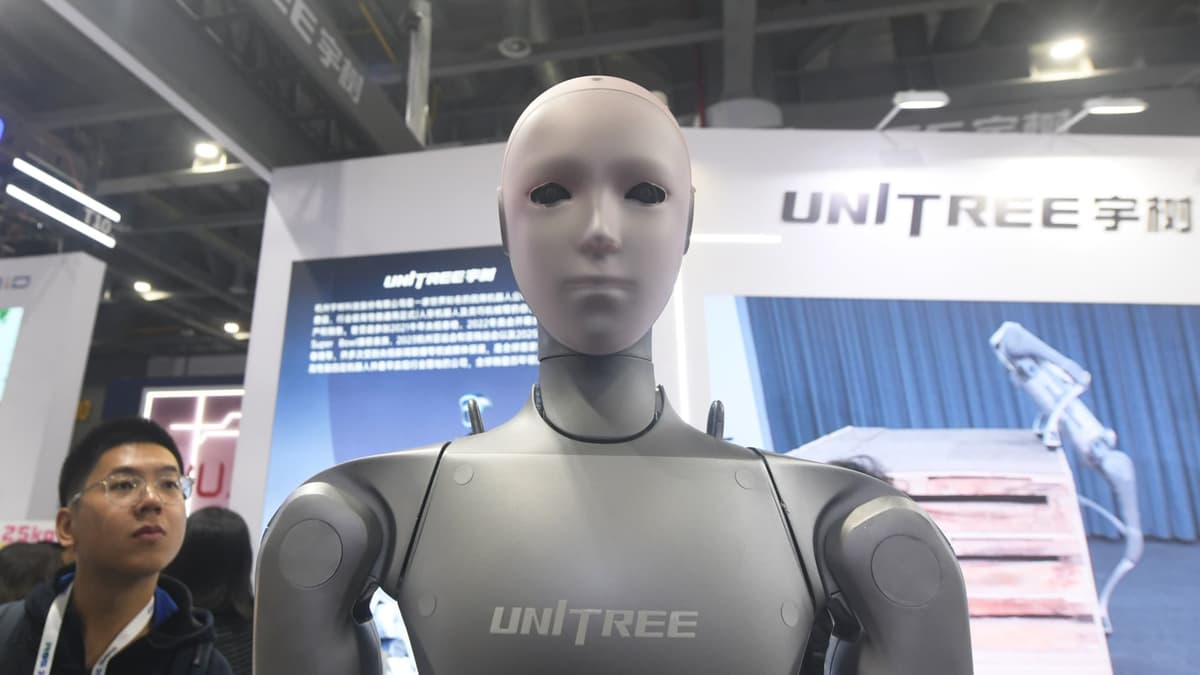
Nvidia Picks Unitree for Humanoid Robot Platform as Chinese Startup Eyes IPO
Companies Mentioned

Why It Matters
The deal gives researchers affordable access to high‑performance AI‑driven humanoids, accelerating robotics innovation, while expanding Nvidia’s revenue beyond GPUs and positioning Unitree for a major capital raise.
Key Takeaways
- •Nvidia's Blackwell chip powers Unitree's 6‑foot H2 humanoid
- •Sales target university labs like Stanford, ETH Zurich, UC San Diego
- •Unitree seeks $620 million IPO on Shanghai STAR board
- •Over 40% of Unitree revenue already comes from overseas markets
Pulse Analysis
Nvidia’s entry into humanoid robotics marks a strategic extension of its AI computing dominance. By embedding the Blackwell GPU—its most advanced AI accelerator—into Unitree’s H2 platform, the company delivers on‑device inference capabilities that were previously limited to data‑center clusters. The bundled software stack, including the Isaac GR00T models and a full simulation pipeline, lets researchers run complex perception and control loops without bespoke engineering. This turnkey solution lowers the barrier for universities and labs to experiment with “physical AI,” a niche that Nvidia has long courted through its CUDA ecosystem.
Unitree’s parallel push for a roughly $620 million listing on Shanghai’s STAR board underscores the commercial potential of the hardware. The Chinese startup already derives more than 40% of its sales from overseas customers, a testament to its growing brand among research institutions worldwide. Analysts estimate the “physical AI” market could eventually reach tens of trillions of dollars, driven by demand for autonomous agents in manufacturing, logistics and service sectors. Nvidia’s partnership therefore not only validates Unitree’s technology but also provides a ready‑made channel for the chipmaker to monetize its AI stack beyond traditional GPU sales.
Despite the hype, widespread deployment of humanoid robots remains constrained by safety, cost and regulatory hurdles. Current adopters are limited to well‑funded university labs such as Stanford, ETH Zurich and UC San Diego, where research budgets can absorb the premium price tag. Competitors like 1X Technologies are pursuing similar general‑purpose designs, but Nvidia’s integrated hardware‑software offering gives it a distinct edge in performance and developer support. If the platform proves reliable, it could accelerate a shift from niche prototypes to scalable solutions in sectors ranging from warehouse automation to elder‑care assistance.
Nvidia picks Unitree for humanoid robot platform as Chinese startup eyes IPO
Comments
Want to join the conversation?
Loading comments...