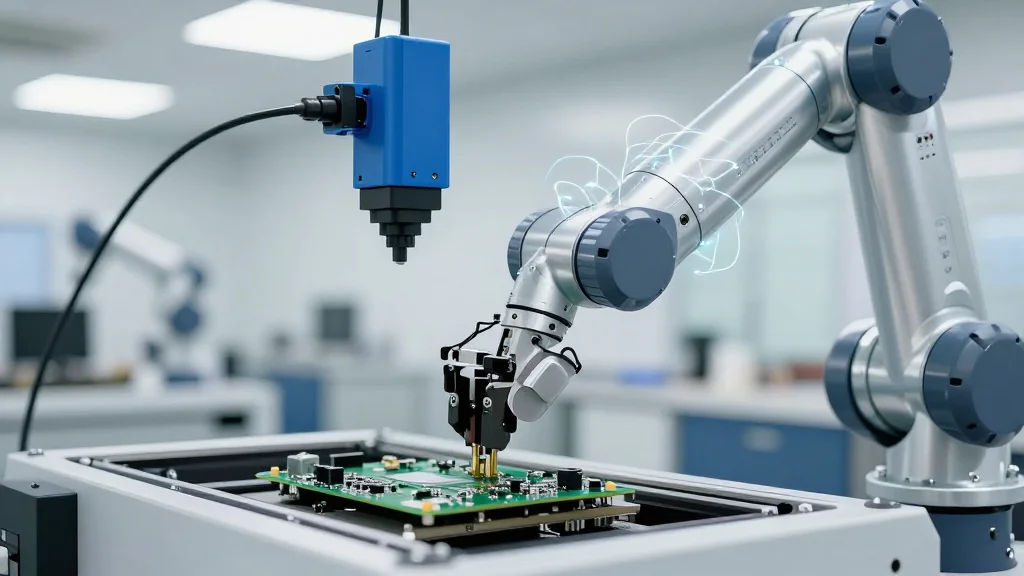
Panasonic Unveils Skill‑Less Autonomous Factory Line at Productronica India 2026

Companies Mentioned
Why It Matters
The shift toward autonomous, software‑centric factories marks a pivotal expansion of autonomy beyond vehicles into core industrial processes. By reducing dependence on specialized labor, manufacturers can achieve higher productivity while mitigating the risks of workforce shortages. Panasonic’s integrated hardware‑software model also illustrates how traditional equipment makers are evolving into platform providers, a trend that could redefine competitive advantage in the manufacturing sector. If the technology proves scalable, it could accelerate India’s ambition to become a leading electronics and semiconductor hub, attracting further foreign investment and fostering a new ecosystem of AI‑enabled supply chains. The broader adoption of such autonomous lines may also drive standards for data interoperability and cybersecurity across the industry.
Key Takeaways
- •Panasonic displayed a complete autonomous production line at Productronica India 2026.
- •The line integrates NPM‑GP/L, NPM‑GH and NPM‑TT2 SMT machines with AI inspection and IoT platforms.
- •PanaCIM and MirAIe ProFactory enable real‑time data analytics and predictive decision‑making.
- •Solutions target automotive, consumer electronics, telecom and semiconductor sectors.
- •Panasonic plans pilot deployments in India later in 2026, with broader rollouts in 2027.
Pulse Analysis
Panasonic’s entry into autonomous factories reflects a broader industry pivot toward end‑to‑end digital ecosystems. Historically, equipment manufacturers sold machines as standalone assets, leaving integration and data management to third‑party system integrators. By bundling AI‑driven software with its hardware, Panasonic is attempting to capture the higher-margin services and recurring revenue associated with platform models. This mirrors trends seen in the automotive sector, where OEMs are embedding software stacks to monetize over‑the‑air updates.
The Indian market offers a compelling testbed. Labor costs are rising, and the country faces a shortage of skilled technicians for advanced manufacturing. Panasonic’s skill‑less proposition directly addresses this gap, potentially giving it a first‑mover advantage in a region projected to host $200 billion in new manufacturing capacity over the next decade. Competitors such as Siemens, ABB and Mitsubishi are also racing to deliver similar integrated solutions, so execution speed and ecosystem partnerships will be decisive.
Looking forward, the success of Panasonic’s autonomous factories will hinge on three factors: the reliability of AI‑driven quality control in high‑mix environments, the ability to secure data across heterogeneous equipment, and the scalability of its software licensing model. If these challenges are met, Panasonic could set a new benchmark for autonomous production, prompting a wave of similar deployments across emerging economies and reshaping the global manufacturing value chain.
Panasonic Unveils Skill‑Less Autonomous Factory Line at Productronica India 2026
Comments
Want to join the conversation?
Loading comments...