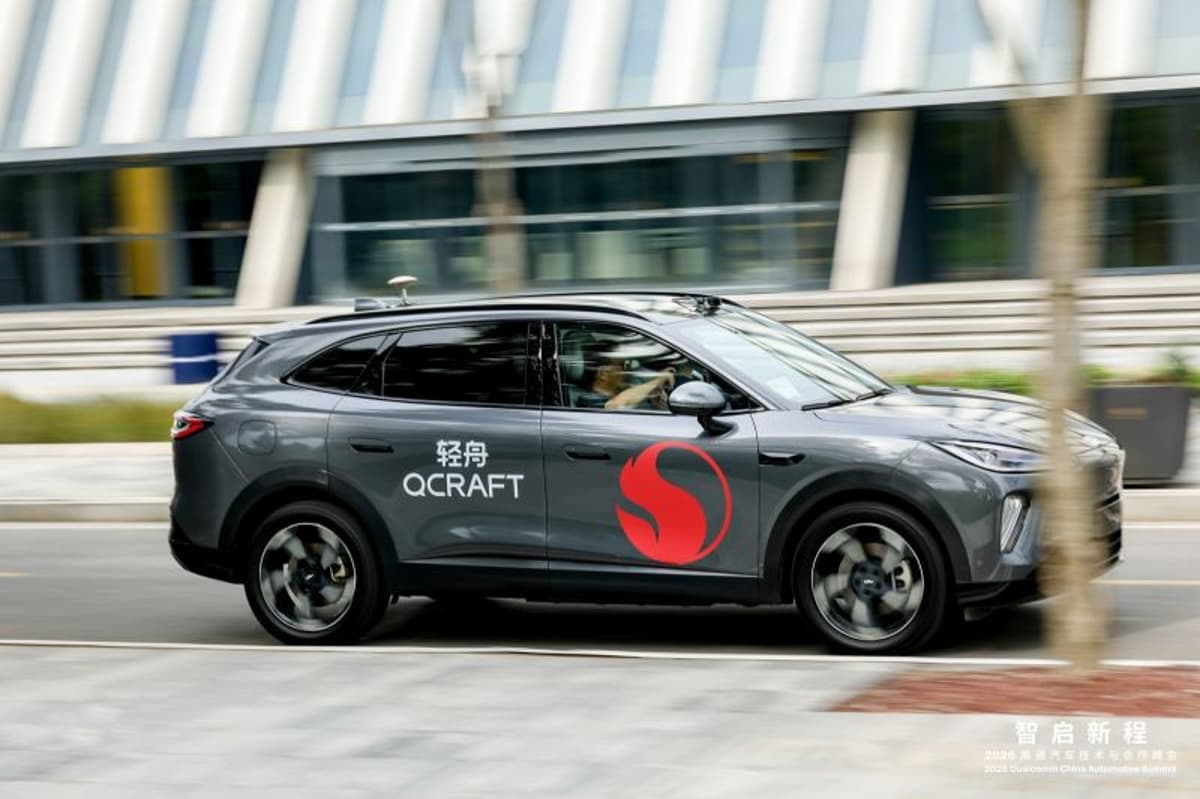
QCraft Demonstrates Urban NOA on Qualcomm’s Latest Snapdragon Ride Chip, Targets 2026 Global Mass Production
Companies Mentioned
Why It Matters
The partnership accelerates the commercialization of high‑compute, city‑scale assisted‑driving technology, promising safer roads and new revenue streams for automakers and chipmakers alike.
Key Takeaways
- •QCraft demoed urban NOA on Snapdragon Ride SA8650P in live traffic.
- •Targeting global mass production of Qualcomm‑based assisted‑driving solutions by 2026.
- •Fleet data shows 3.5 billion km driven, <1 false AEB per 500k km.
- •QPilot now on ~30 models; 50 more slated for 2026.
- •QCraft’s cloud world model enables zero‑shot scenario generation via natural language.
Pulse Analysis
Qualcomm’s Snapdragon Ride platform is emerging as a serious contender in the automotive silicon arena, where Nvidia’s Drive and Horizon Robotics have traditionally dominated. By integrating the SA8650P chip into production‑grade vehicles, QCraft demonstrates that the hardware can handle the compute‑intensive demands of city‑scale navigate‑on‑autopilot, from unprotected left turns to dense pedestrian interactions. This proof point not only validates Qualcomm’s roadmap but also signals to OEMs that a diversified supplier base is now viable for advanced driver‑assistance systems (ADAS).
QCraft’s extensive fleet data underpins its safety narrative: more than 3.5 billion user‑driven kilometers, over 100 million parking‑assist events, and an automatic emergency braking false‑trigger rate of less than one per 500,000 km. The company estimates its technology prevents roughly 146,000 accidents annually, a compelling figure for insurers and regulators. Beyond raw metrics, QCraft’s cloud‑based world model and zero‑shot scenario generation illustrate a shift toward “physical AI,” where large‑scale simulation and reinforcement learning accelerate development cycles without costly real‑world testing.
Looking ahead, the 2026 mass‑production target aligns with a broader industry inflection point: assisted‑driving functions are transitioning from niche features to core vehicle platforms. Automakers that adopt Qualcomm‑powered solutions can leverage a unified hardware stack for both highway and urban contexts, simplifying integration and reducing time‑to‑market. As the ecosystem matures, we can expect a cascade of new business models—from subscription‑based ADAS services to data‑monetization opportunities—driven by the scalability and safety assurances demonstrated by QCraft and its Snapdragon Ride partnership.
QCraft demonstrates urban NOA on Qualcomm’s latest Snapdragon Ride chip, targets 2026 global mass production
Comments
Want to join the conversation?
Loading comments...