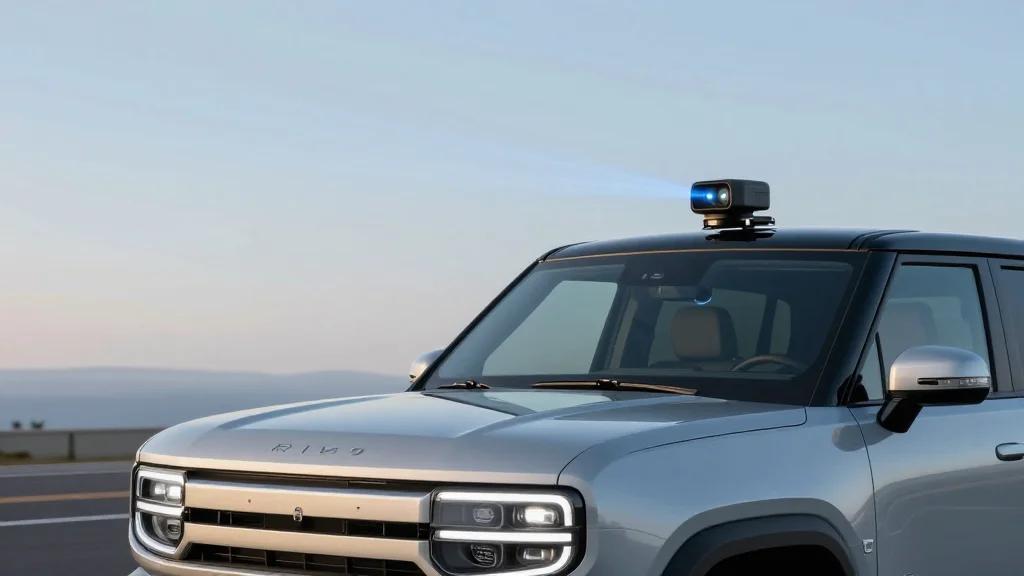
Rivian Sets 2026 Target for Point‑to‑Point Hands‑Free Navigation to Challenge Tesla FSD

Companies Mentioned
Why It Matters
Rivian’s commitment to point‑to‑point hands‑free navigation signals a strategic escalation in the consumer autonomy race. By aiming to match or exceed Tesla’s FSD capabilities, Rivian forces the market to confront the trade‑offs between camera‑only systems and lidar‑enhanced perception. The decision to explore domestic lidar production also touches on geopolitical concerns, potentially reshaping supply‑chain dynamics for autonomous hardware in the United States. A successful 2026 launch would give Rivian a unique selling proposition beyond its electric‑vehicle pedigree, attracting buyers who prioritize full autonomy. Conversely, failure to deliver could reinforce Tesla’s dominance and deter other challengers from investing heavily in lidar, consolidating the camera‑first approach as the industry standard.
Key Takeaways
- •Rivian targets end‑2026 for point‑to‑point hands‑free navigation on its R2 model.
- •CEO RJ Scaringe is exploring an in‑house lidar joint venture to reduce reliance on Chinese suppliers.
- •Tesla’s FSD has logged 3.6 billion autonomous miles, nearly triple the figure a year earlier.
- •Elon Musk continues to dismiss lidar as unnecessary, while NHTSA escalates its FSD safety investigation.
- •Rivian’s move could reshape U.S. autonomous‑hardware supply chains and intensify competition for consumer autonomy.
Pulse Analysis
Rivian’s 2026 autonomy ambition is more than a product roadmap; it’s a calculated bet on technology differentiation. Tesla’s lead rests on an unmatched data moat, but that advantage is vulnerable to regulatory scrutiny and the limitations of a pure camera stack. By integrating solid‑state lidar, Rivian could achieve higher perception fidelity, especially in adverse weather, potentially delivering a safer, more reliable hands‑free experience.
Historically, the autonomous‑driving field has swung between lidar‑heavy and camera‑only philosophies. Companies like Waymo and Cruise have invested heavily in lidar, while Tesla has championed a vision‑only approach. Rivian’s hybrid strategy—leveraging lidar while maintaining a camera suite—mirrors the middle ground that many analysts consider the most pragmatic path to Level 4 autonomy. If Rivian can commercialize a cost‑effective lidar solution domestically, it may set a new benchmark for U.S. manufacturers, encouraging a shift away from Chinese component dependence.
Looking ahead, the success of Rivian’s 2026 target will hinge on three factors: the maturity of its lidar partnership, the ability to process massive sensor data in real time, and regulatory clearance from bodies like the NHTSA. Investors should monitor prototype rollouts, any announced joint‑venture partners, and the outcomes of ongoing safety investigations. A breakthrough could catalyze a wave of new entrants, while a setback may reaffirm Tesla’s market dominance and reinforce the camera‑only narrative.
Rivian Sets 2026 Target for Point‑to‑Point Hands‑Free Navigation to Challenge Tesla FSD
Comments
Want to join the conversation?
Loading comments...