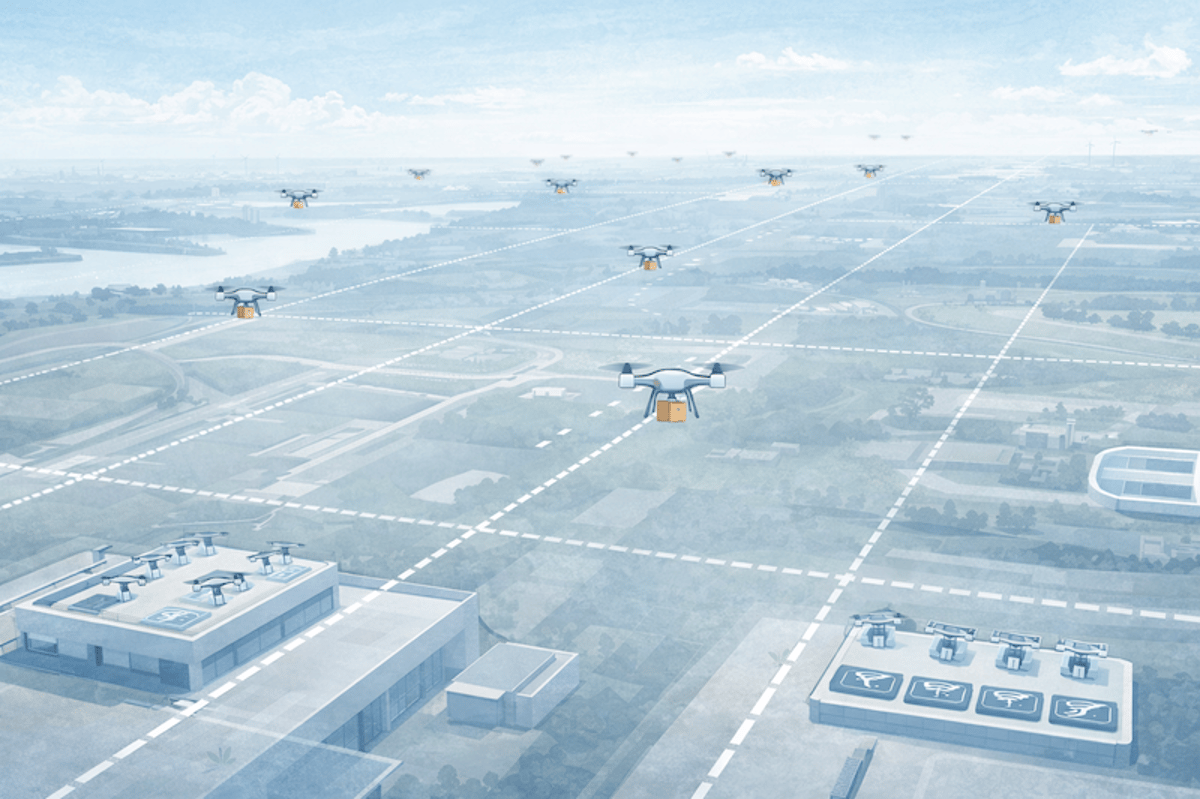
Robotics & Automation News Publishes In-Depth Trend Analysis on the Future of Drone Logistics
•February 13, 2026
0
Why It Matters
The analysis provides decision‑makers with data‑driven insights on where drone logistics can generate real value, informing investment and strategy in a rapidly maturing market.
Key Takeaways
- •Drone delivery moving from pilots to repeatable operations
- •Regulatory clarity improving in key regions worldwide
- •Viable economics only in time‑critical, constrained routes
- •Infrastructure and airspace integration remain major adoption barriers
- •Market fragments into distinct commercial pathways by 2030
Pulse Analysis
The drone logistics sector has progressed beyond experimental pilots, entering a phase where repeatable, commercial‑grade operations are becoming the norm. This transition is driven by a convergence of technology maturity, clearer airspace regulations, and the need for faster, last‑mile solutions in dense urban cores and remote locations. By mapping the evolution from innovation‑centric trials to scalable services, the new report underscores how aerial delivery is carving out a niche rather than attempting to overhaul existing ground networks.
Economic viability remains the linchpin for widespread adoption. While early pilots often showcased impressive speed, they struggled with unit cost parity against traditional couriers. The analysis details how specific use cases—such as medical supplies, perishable goods, and emergency parts—achieve cost competitiveness when distance is short and time is critical. Regulatory progress in regions like the United States, Europe, and parts of Asia is reducing compliance uncertainty, yet operators still face substantial capital outlays for vertiports, charging stations, and sophisticated traffic‑management systems.
For logistics leaders, retailers, and healthcare providers, the report offers a strategic roadmap. Companies can evaluate whether to partner with established drone vendors, develop in‑house capabilities, or focus on hybrid models that integrate aerial nodes into existing distribution hubs. Anticipating fragmented market pathways—each defined by distinct economic thresholds and regulatory environments—will enable firms to allocate capital efficiently and capture early‑mover advantages in high‑value segments. As the industry heads toward 2030, the ability to align technology, policy, and business models will determine which players thrive in the aerial delivery ecosystem.
Robotics & Automation News publishes in-depth trend analysis on the future of drone logistics
0
Comments
Want to join the conversation?
Loading comments...