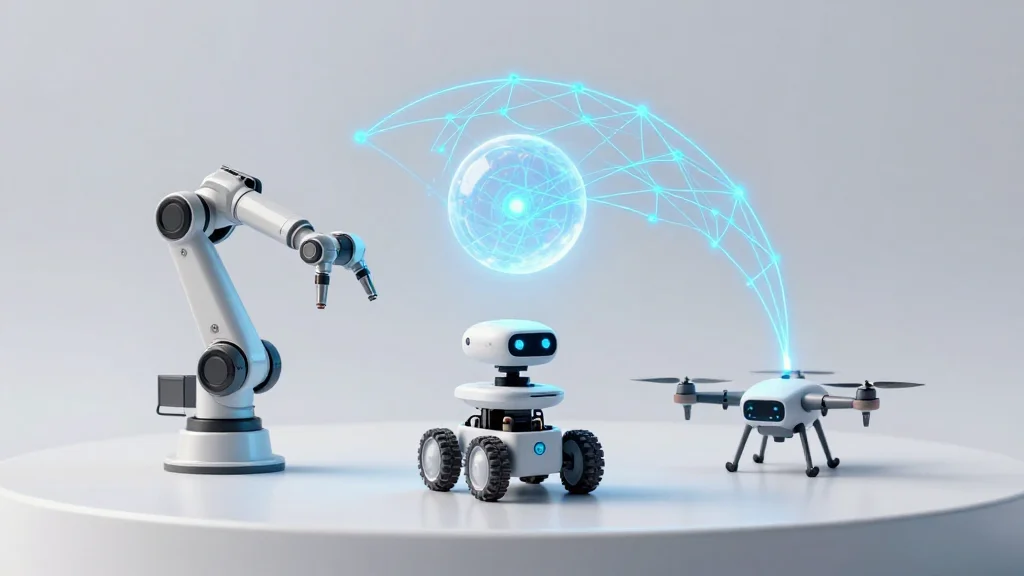
Robots with Different Bodies Can Now Share Skills: What Intention-Based Learning Changes
Why It Matters
IAIL reduces the engineering overhead of re‑programming each robot, accelerating deployment of flexible multi‑robot systems in manufacturing, agriculture, and healthcare. Its language‑based framework also enhances human‑robot interaction by making robot intentions more transparent.
Key Takeaways
- •IAIL enables cross-robot skill transfer via language goals
- •Tested on seven robots across 30 scenarios
- •Removes need for identical hardware for imitation learning
- •Supports team collaboration and human‑robot interaction
- •Aligns motion embeddings with natural‑language intent descriptors
Pulse Analysis
The emergence of intention‑aligned imitation learning marks a shift from low‑level motion replication to goal‑centric teaching in robotics. Traditional imitation frameworks required near‑identical kinematics between demonstrator and learner, limiting scalability across diverse platforms. IAIL sidesteps this constraint by encoding tasks as natural‑language intents, then mapping those intents onto each robot's unique motion repertoire. This abstraction not only streamlines skill transfer but also opens the door for rapid re‑deployment of existing robot fleets into new roles without extensive re‑coding.
From an industry perspective, the ability to convey intent rather than precise trajectories aligns closely with how human operators communicate tasks on the shop floor. Production lines can now program a single high‑level instruction—"pick and place the pallet"—and let each robot, whether a wheeled AGV or a articulated arm, interpret and execute it according to its own capabilities. Such flexibility reduces downtime, cuts integration costs, and accelerates adoption of collaborative robots in sectors like precision agriculture, where equipment varies widely in size and function.
Beyond operational efficiency, IAIL’s shared intention space enhances safety and trust in human‑robot collaboration. By translating robot actions into human‑readable goals, operators gain clearer insight into robot decision‑making, fostering predictability and smoother teamwork. Researchers anticipate that this paradigm will spur further advances in multi‑agent AI, enabling heterogeneous robot teams to coordinate complex tasks such as disaster response or large‑scale logistics with minimal human oversight. The convergence of natural‑language processing and robotics thus promises a more adaptable, intuitive, and economically viable future for automation.
Robots with different bodies can now share skills: What intention-based learning changes
Comments
Want to join the conversation?
Loading comments...