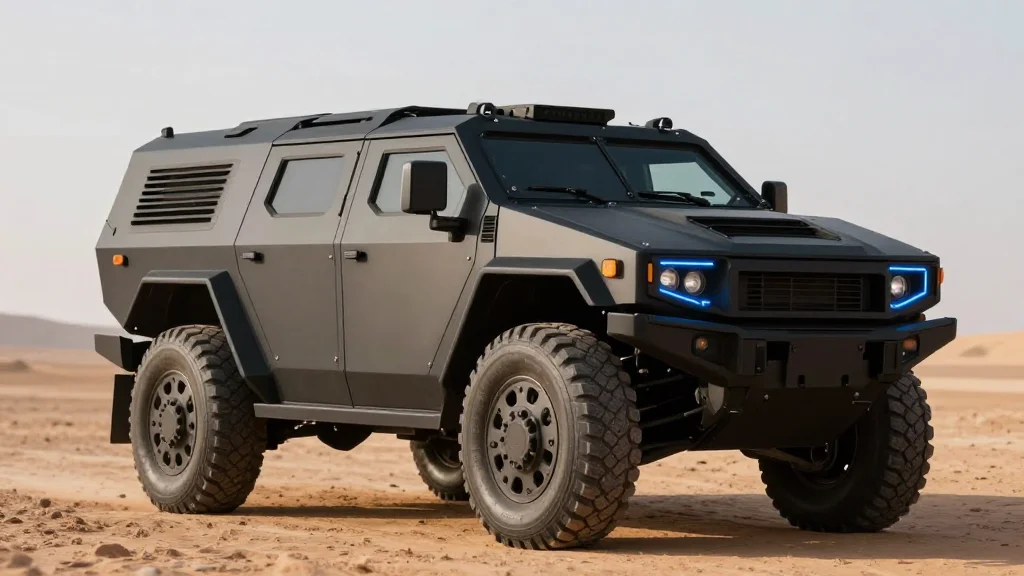
Scout AI Secures $100 Million Series A to Build Autonomous Military ATVs

Companies Mentioned
Why It Matters
Scout AI’s $100 million raise underscores the accelerating investment in AI‑driven weapon systems, a sector that blends cutting‑edge robotics with national security priorities. By leveraging VLA models, Scout aims to deliver a level of general intelligence that can adapt to the unpredictable terrain of combat zones, potentially reshaping how the U.S. military conducts logistics and fire‑support missions. The infusion of capital also signals confidence from venture firms that the commercial‑to‑defense pipeline can produce viable, scalable autonomous platforms within a few years. If successful, Scout’s Fury model could set a benchmark for autonomous vehicle autonomy, influencing both defense procurement strategies and civilian off‑road robotics. The partnership with the 1st Cavalry Division provides a real‑world proving ground, and the upcoming 2027 deployment window could accelerate policy discussions around ethical use, command‑and‑control safeguards, and the broader implications of AI‑enabled lethal systems.
Key Takeaways
- •Scout AI raised $100 million Series A led by Align Ventures and Draper Associates
- •Series A follows a $15 million seed round in Jan 2025
- •Company has $11 million in DoD contracts from DARPA and Army Applications Lab
- •Developing "Fury" AI model for autonomous military ATVs and future weaponization
- •Integrated into U.S. Army 1st Cavalry Division training; deployment targeted for 2027
Pulse Analysis
Scout AI’s financing marks a watershed moment for the defense autonomy market, where venture capital is now directly fueling battlefield‑ready AI. Historically, military robotics have been dominated by legacy contractors with long procurement cycles. Scout’s rapid capital raise and its use of VLA models—technology only a few years old—compress that timeline dramatically. By marrying LLM‑based reasoning with real‑world vehicle control, Scout is attempting to leapfrog the incremental sensor‑fusion approaches that have limited prior autonomous vehicle performance in unstructured environments.
The involvement of Align Ventures and Draper Associates also hints at a broader shift: investors are no longer content with peripheral defense AI applications (e.g., logistics software) and are moving toward platforms that could directly influence kinetic outcomes. This raises both competitive and regulatory stakes. Competitors such as Physical Intelligence and Figure.AI are also exploring VLA‑driven robotics, but Scout’s direct access to Army testing grounds gives it a distinct advantage in data collection and iterative development. The $11 million contract portfolio, while modest compared to the Series A, provides a credible foothold within the DoD’s innovation ecosystem, potentially unlocking larger multi‑year procurement deals.
Looking ahead, the key risk lies in the transition from controlled training environments to contested battlefields. The U.S. Department of Defense is still grappling with policy frameworks for autonomous weapons, and any misstep could trigger congressional scrutiny or export‑control hurdles. Nonetheless, if Scout can demonstrate reliable autonomous logistics and weaponized capabilities by 2027, it could set a new standard for AI‑enabled combat platforms, prompting a cascade of follow‑on investments and accelerating the militarization of advanced AI across allied forces.
Scout AI Secures $100 Million Series A to Build Autonomous Military ATVs
Comments
Want to join the conversation?
Loading comments...