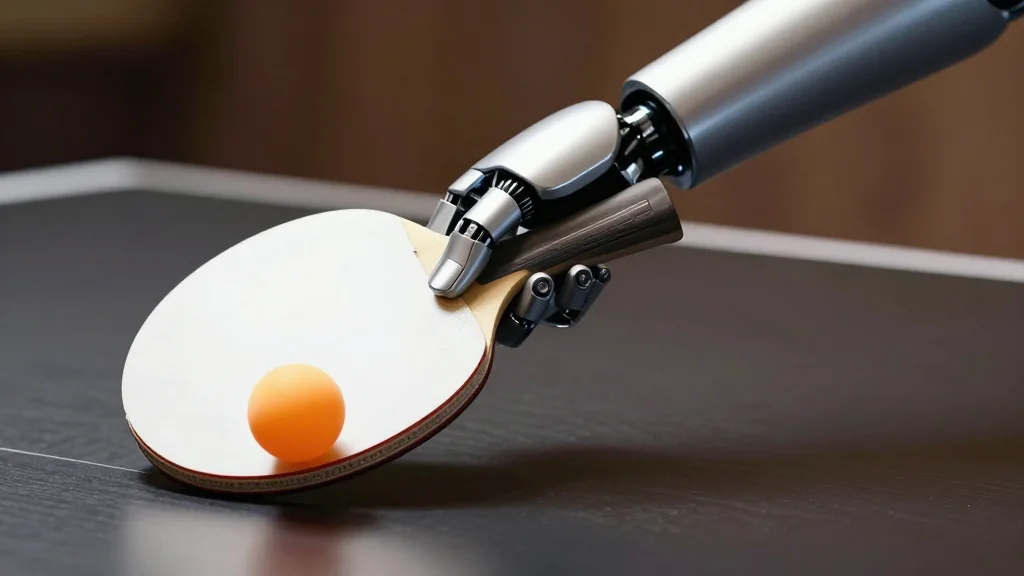
Sony AI’s Robot Ace Beats Elite Humans in Table Tennis, Marking First Real‑World AI Victory

Companies Mentioned
Why It Matters
The Ace breakthrough signals that AI is moving from simulated environments into the messy, high‑speed physical world, a transition that has been a major barrier for autonomous systems. Demonstrating expert‑level performance in a sport that demands rapid perception, precise motor control, and strategic adaptation suggests that similar technologies could soon be deployed in sectors where timing and accuracy are critical, such as surgical robotics or autonomous vehicle navigation in complex urban traffic. Moreover, the public nature of the competition—conducted under official ITTF rules against recognized elite athletes—provides a transparent benchmark for measuring progress in embodied AI. This could standardize performance metrics across the industry, guiding both research agendas and investment decisions.
Key Takeaways
- •Ace won 3 of 5 matches against elite table‑tennis players under ITTF rules
- •Additional trials in Dec 2025 and Mar 2026 added 4 elite and 2 professional opponents, with Ace beating 3 of them
- •Sony AI combined advanced sensors, reinforcement learning, and precision hardware to achieve millisecond‑scale decision making
- •The research extends Sony’s prior virtual‑domain AI success with Gran Turismo Sophy™ into physical robotics
- •Next public showcase scheduled for the International Robotics Expo in Tokyo later 2026
Pulse Analysis
Sony AI’s Ace represents a watershed moment for embodied artificial intelligence, but the broader impact will depend on how quickly the underlying technology can be generalized beyond a single sport. The robot’s success hinges on a tightly integrated stack—high‑resolution vision, ultra‑low‑latency planning, and actuators capable of sub‑10‑millisecond response times. Replicating that hardware‑software synergy in other domains will require substantial engineering effort and capital, especially for applications where safety margins are tighter than a table‑tennis rally.
Competitors such as Boston Dynamics and Agility Robotics have long pursued dynamic locomotion and manipulation, yet few have demonstrated the kind of split‑second strategic reasoning that Ace exhibits. Sony’s advantage lies in its sensor ecosystem, originally developed for consumer electronics, which can be repurposed for robotics. If Sony can commercialize these components, it may set a new performance baseline that forces the rest of the industry to accelerate its own sensor‑fusion research.
From a market perspective, the breakthrough could unlock new revenue streams for Sony AI, ranging from licensing its control algorithms to partnering with manufacturers seeking high‑speed automation. However, regulatory scrutiny will intensify as autonomous agents begin to operate alongside humans in public venues. Policymakers will need to define safety standards that account for AI systems capable of reacting faster than human reflexes. The next few years will likely see a tug‑of‑war between rapid technological deployment and the establishment of robust oversight mechanisms.
Sony AI’s Robot Ace Beats Elite Humans in Table Tennis, Marking First Real‑World AI Victory
Comments
Want to join the conversation?
Loading comments...