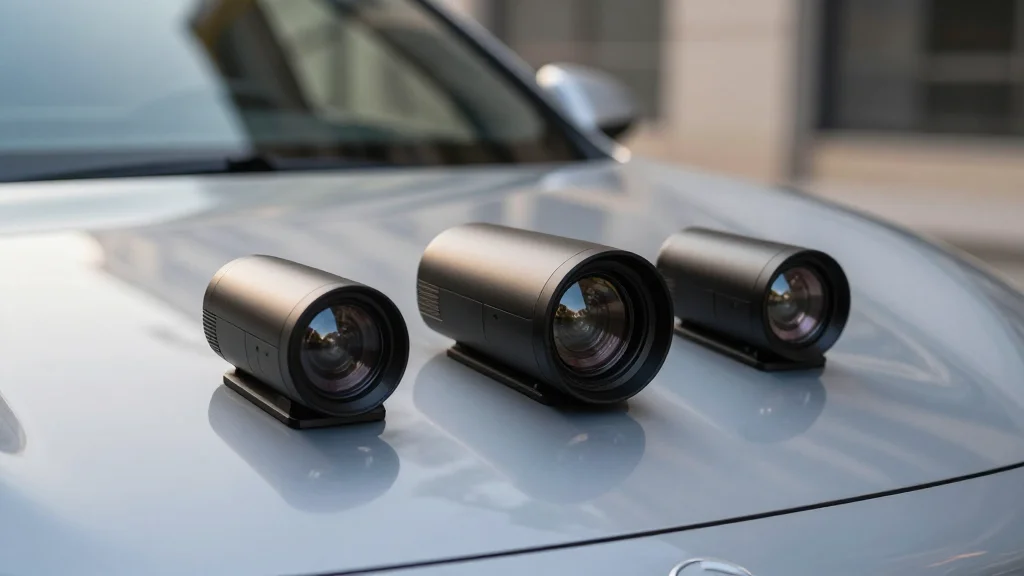
STRADVISION Unveils Production-Ready Integrated Perception Platform, Raising ADAS Benchmark

Companies Mentioned
Why It Matters
The STRADVISION platform could compress the development timeline for Level 2+ ADAS, enabling automakers to bring semi‑autonomous features to market faster and at lower cost. By delivering a pre‑validated, safety‑compliant stack, the solution addresses a chronic pain point—software integration risk—that has slowed OEM adoption of advanced driver assistance. If the platform gains traction, it may set a new industry baseline for perception performance, compelling rivals to consolidate their own software stacks or partner with specialized AI firms. This could accelerate the overall pace of autonomous vehicle development, as higher‑level autonomy builds on robust Level 2+ foundations.
Key Takeaways
- •STRADVISION launches production‑ready integrated perception platform for Level 2+ ADAS
- •Multi‑year partnership with a leading Physical AI systems developer provides a validated sensor‑to‑system stack
- •Platform targets final delivery to OEMs by Q3 2026 and supports global safety standards (FMVSS, GSR2, ISO 26262)
- •Modular architecture aims to cut ADAS development cycles from 12‑18 months to under a year
- •Launch positions STRADVISION against incumbents like Mobileye and Nvidia, potentially reshaping pricing dynamics
Pulse Analysis
STRADVISION’s announcement reflects a broader industry pivot from piecemeal ADAS components toward holistic perception platforms. Historically, OEMs have shouldered the integration burden, stitching together disparate sensor suites, perception algorithms and safety‑critical middleware. This fragmented approach not only inflates development costs but also introduces latency and reliability challenges that can jeopardize regulatory approval. By delivering a turnkey, pre‑validated stack, STRADVISION is effectively commoditizing the perception layer, allowing OEMs to focus resources on vehicle integration and user experience.
The competitive implications are significant. Legacy suppliers have relied on deep pockets and extensive validation pipelines to justify premium pricing. STRADVISION’s claim of delivering comparable performance at a “fraction of the market cost” could force a price war, especially as Tier‑1s seek to offload perception development to specialized AI firms. Moreover, the platform’s modularity aligns with the industry’s move toward software‑defined vehicles, where updates can be rolled out over‑the‑air. If STRADVISION can demonstrate consistent real‑world performance, it may become the de‑facto standard for Level 2+ systems, compelling rivals to either acquire similar capabilities or double down on proprietary solutions.
Looking ahead, the platform’s success hinges on OEM adoption rates and the ability to meet stringent safety certifications across regions. The Q3 2026 delivery window is ambitious, given the need for extensive validation under diverse driving conditions. However, STRADVISION’s existing certifications (ISO 26262, TISAX AL3) and its global engineering footprint provide a solid foundation. Should the rollout prove smooth, the company could leverage this momentum to accelerate its roadmap toward Level 3 and beyond, potentially reshaping the competitive hierarchy in autonomous driving technology.
STRADVISION Unveils Production-Ready Integrated Perception Platform, Raising ADAS Benchmark
Comments
Want to join the conversation?
Loading comments...