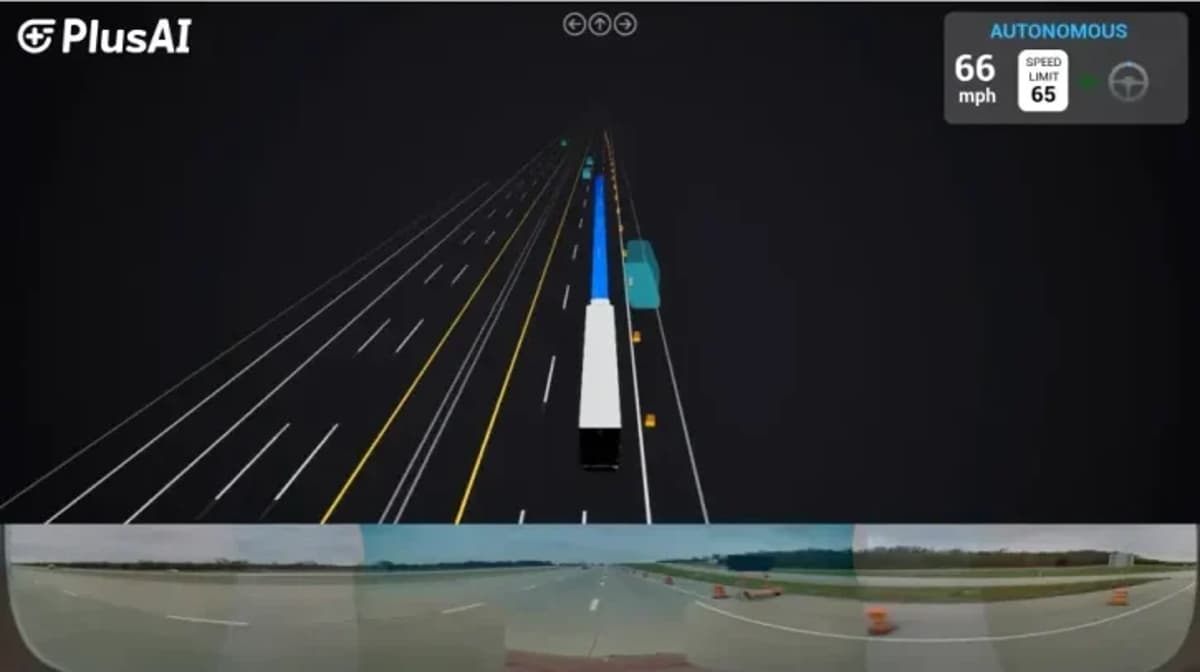
SuperDrive 6.0 From PlusAI Enables Night Driving and Construction Zone Handling
•March 6, 2026
0
Why It Matters
Enabling 24/7 freight and safer navigation through work zones dramatically improves truck utilization and lowers operational costs, accelerating the commercial rollout of driverless logistics.
Key Takeaways
- •Night driving unlocks 24/7 autonomous freight
- •Construction‑zone handling expands operational envelope
- •AI training speed increased tenfold
- •Data‑labeling costs cut three times
- •Targeting full driverless trucks by 2027
Pulse Analysis
SuperDrive 6.0 marks a turning point for autonomous freight by finally tackling two of the most stubborn operational constraints: darkness and construction zones. Night‑time capability allows trucks to run continuously, potentially doubling asset utilization and cutting delivery windows for shippers. Handling temporary work zones, where lane markings shift and workers appear unpredictably, expands the geographic footprint of driverless routes, especially on busy interstate corridors that undergo frequent maintenance. Early deployments in Texas demonstrate that these features are not merely laboratory proofs but are already supporting real‑world loads, giving PlusAI a tangible edge in the race for 24/7 logistics.
The software upgrade is underpinned by a ten‑fold acceleration in AI model training and a three‑fold drop in data‑labeling expenses, thanks to an integrated pipeline of autolabeling, imitation learning and reinforcement learning. At its core, the new Transformer‑based Reflex layer fuses large‑scale perception with motion forecasting, delivering a two‑times improvement in predicting dynamic actors’ trajectories. Distributed compute across Nvidia Drive Orin and Thor chips ensures resilience against sensor degradation and partial hardware failures, a prerequisite for commercial reliability. These technical gains compress the simulation‑to‑road cycle to weeks, slashing time‑to‑revenue and improving unit economics for fleet operators.
From a market perspective, PlusAI’s announcement arrives as the company prepares a SPAC merger with Churchill Capital Corp IX, positioning it for public capital to fund the 2027 launch of factory‑built driverless trucks. Competitors such as Waymo, TuSimple and Aurora are also racing to certify night‑time operation, but PlusAI’s rapid feature rollout and cost‑saving architecture could accelerate its market share capture. Regulators are increasingly receptive to data‑driven safety cases, and the demonstrated ability to handle construction zones may ease permitting hurdles. If the company sustains its development tempo, the freight sector could see a swift shift toward fully autonomous, round‑the‑clock deliveries.
SuperDrive 6.0 from PlusAI enables night driving and construction zone handling
0
Comments
Want to join the conversation?
Loading comments...