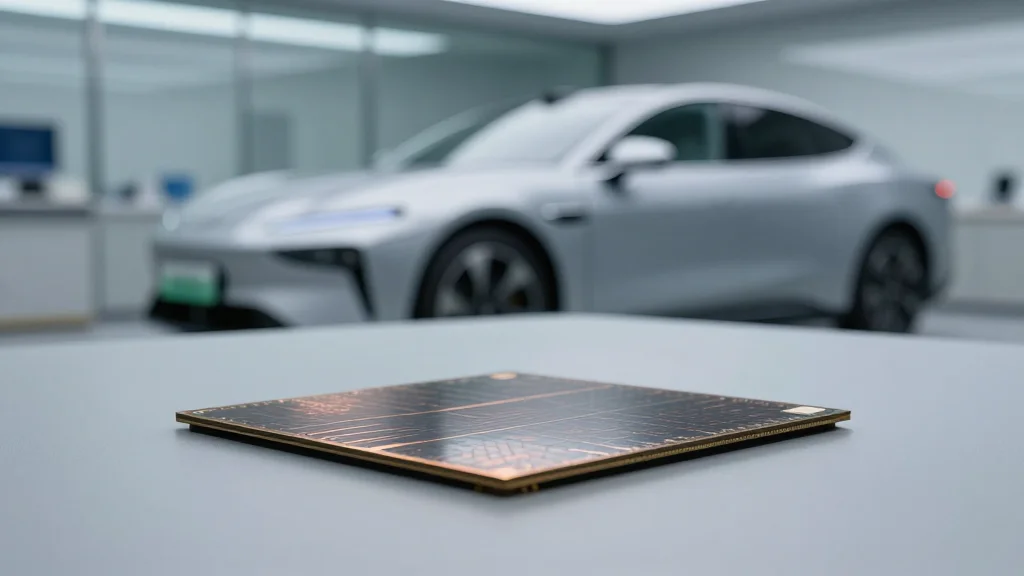
Tesla Beats Estimates and Unveils 'Terafab' Chip Strategy to Accelerate Autonomy

Companies Mentioned

Why It Matters
Tesla’s decision to build its own semiconductor fab directly impacts the economics and speed of autonomous‑vehicle development. By internalizing chip production, Tesla could lower per‑unit costs for its FSD hardware, accelerate software‑hardware co‑design, and reduce exposure to supply‑chain disruptions that have plagued the broader auto industry. This shift also pressures independent chip makers to innovate faster or seek niche markets, potentially consolidating the autonomous‑tech supply chain. Beyond Tesla, the move signals to investors that hardware control remains a decisive competitive edge in autonomy. Companies that rely on third‑party silicon may face higher margins pressure, while those that can demonstrate rapid iteration cycles could attract the next wave of capital. The ripple effect may reshape venture‑capital allocation, with more funds flowing toward firms that can complement or compete with Tesla’s vertical integration strategy.
Key Takeaways
- •Tesla posted adjusted earnings of $0.41 per share, beating expectations.
- •The company hinted at an internal semiconductor venture called "Terafab" during its earnings call.
- •Terafab aims to keep the entire chip design and manufacturing loop in‑house to speed up FSD development.
- •Shares rose about 4% in after‑hours trading following the earnings beat and chip announcement.
- •Analysts see the move as a potential catalyst for reshaping the autonomous‑chip supply chain.
Pulse Analysis
Tesla’s Terafab announcement is less a product launch than a strategic signal. Historically, the company has relied on Nvidia’s Drive chips for its FSD computers, paying premium prices for performance and flexibility. By moving chip design and fabrication under one roof, Tesla is attempting to compress the classic semiconductor feedback loop—design, test, iterate—into a single, tightly coordinated process. This could shave months off the development cycle, a critical advantage in an industry where software updates are as valuable as hardware upgrades.
The broader autonomous market has been fragmented, with multiple players offering proprietary stacks that often depend on external silicon partners. Tesla’s vertical integration threatens to tilt the balance toward a model where the vehicle manufacturer also becomes the chip supplier, echoing trends in consumer electronics where Apple designs its own silicon. If Tesla can deliver a cost‑effective, high‑performance autonomous chip, it may force rivals to either double‑down on differentiation (e.g., lidar‑centric solutions) or pursue similar in‑house strategies, potentially accelerating consolidation.
Investors should monitor two key metrics: the capital allocation disclosed for Terafab and any early performance data linking the new chips to FSD improvements. A successful rollout could justify higher valuations for Tesla and pressure the market to re‑price autonomous‑chip stocks. Conversely, delays or cost overruns could expose Tesla to margin compression and erode the competitive edge it hopes to secure. The next earnings season will be the first real test of whether Terafab is a game‑changing innovation or an ambitious, yet costly, experiment.
Tesla Beats Estimates and Unveils 'Terafab' Chip Strategy to Accelerate Autonomy
Comments
Want to join the conversation?
Loading comments...