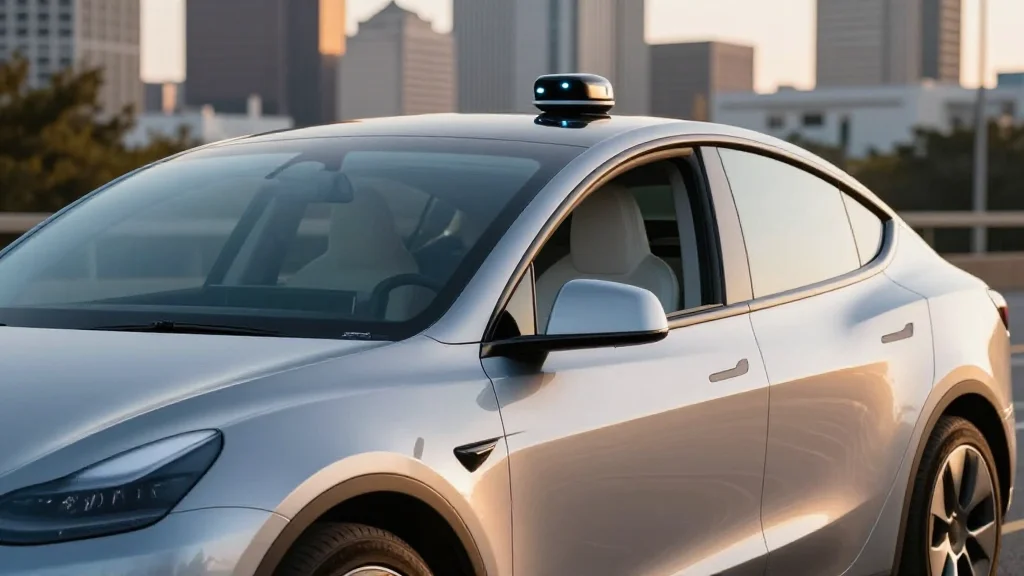
Tesla Expands Unsupervised Robotaxi Service to Entire Austin Metro, Adding 42 Vehicles

Companies Mentioned
Why It Matters
Tesla’s Austin expansion signals the company’s confidence that its Full Self‑Driving software can operate without a human safety driver, a milestone that could unlock a new, high‑margin revenue stream. By moving from a pilot to a city‑wide service, Tesla forces regulators, insurers, and competitors to confront the practical realities of unsupervised autonomous rides, from safety validation to liability frameworks. The rollout also intensifies the competitive dynamics with Waymo, whose larger fleet currently offers more reliable service, highlighting the importance of software upgrades (v15) and fleet scaling for market leadership. Beyond the immediate market, the expansion underscores a broader industry shift: automakers are betting on AI‑driven mobility services to sustain growth as EV margins compress. If Tesla can demonstrate safe, large‑scale unsupervised operation, it may accelerate adoption of autonomous ride‑hailing across other U.S. cities and influence global standards for driverless technology.
Key Takeaways
- •Tesla’s unsupervised robotaxi service now covers the entire Austin metro area.
- •Fleet size grew to roughly 42 registered vehicles, about 21 operating without a safety driver.
- •Waymo maintains a larger presence with 619 autonomous vehicles in Austin.
- •Tesla shares rose 14.2% in May on optimism about robotaxi revenue potential.
- •Elon Musk says FSD v14.3 is the last piece before large‑scale rollout, but v15 will bring major safety upgrades.
Pulse Analysis
Tesla’s decision to push unsupervised robotaxis city‑wide is as much a strategic bet on data acquisition as it is a product launch. Each autonomous mile generates high‑resolution sensor logs that feed the neural‑network training loop, accelerating the path to a more robust v15. In contrast, Waymo’s advantage lies in fleet density, which translates into better coverage, shorter wait times, and a richer dataset per vehicle. Tesla’s leaner fleet may struggle to match Waymo’s service quality unless the software leap dramatically reduces incident rates.
The market reaction—Tesla’s stock jump—reflects investor appetite for a recurring‑revenue model that could offset the cyclical nature of vehicle sales. Yet the pause in fleet expansion after May 10 suggests internal constraints, possibly related to safety validation or regulatory approvals. If Tesla can resolve these bottlenecks and deliver a truly driverless experience, it could force a re‑pricing of autonomous‑vehicle equities, pressuring rivals to accelerate their own software upgrades.
Looking ahead, the rollout to Dallas and Houston will test Tesla’s ability to replicate the Austin model in markets with different traffic patterns and regulatory environments. Success could catalyze a wave of city‑wide deployments, reshaping urban mobility and creating a new competitive frontier where software, not hardware, determines market share. Conversely, any high‑profile safety incident could trigger stricter oversight, slowing the industry’s momentum and reinforcing the advantage of firms with larger, more proven fleets.
Tesla Expands Unsupervised Robotaxi Service to Entire Austin Metro, Adding 42 Vehicles
Comments
Want to join the conversation?
Loading comments...