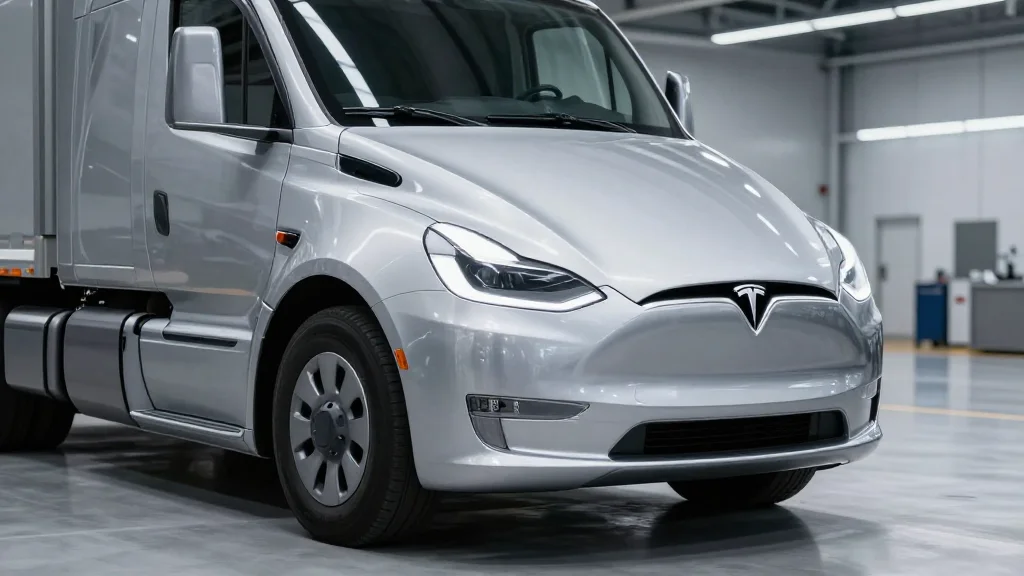
Tesla Launches Nevada Semi Truck Factory to Produce 50,000 Autonomous Trucks Annually

Companies Mentioned
Why It Matters
The launch of a dedicated Semi factory signals Tesla’s transition from prototype to mass‑production of autonomous freight trucks, a segment that could dominate long‑haul logistics as emissions regulations tighten. By coupling vehicle assembly with battery manufacturing, Tesla reduces a key cost driver, potentially making electric trucks price‑competitive with diesel. The early adoption by major retailers underscores a market appetite for lower‑cost, lower‑emission logistics solutions, which could accelerate the shift toward autonomous, electric supply chains. If Tesla meets its 50,000‑truck target, the company could capture a sizable share of the $200 billion U.S. freight market, forcing incumbents to rethink fleet composition and invest heavily in their own electric and autonomous technologies. The factory also serves as a testbed for scaling the Full Self‑Driving system in commercial settings, a capability that, if proven, would redefine driver labor costs and route optimization across the industry.
Key Takeaways
- •Tesla opened a 1.7 M‑sq‑ft Semi truck factory near Reno, Nevada.
- •Annual production goal set at 50,000 autonomous trucks.
- •Volume production begins March 2026, leveraging adjacent Gigafactory battery supply.
- •PepsiCo and Walmart have placed early orders, citing lower total ownership costs.
- •Tesla will expand its Megacharger network to support high‑power truck charging.
Pulse Analysis
Tesla’s decision to locate the Semi plant beside its Sparks Gigafactory is a strategic masterstroke that tackles one of the biggest hurdles for electric trucks: battery availability. By integrating battery output directly into the assembly line, Tesla can shave weeks off the production cycle, a competitive edge that traditional truck makers, reliant on third‑party suppliers, will struggle to match. This vertical integration also gives Tesla tighter control over battery chemistry and cost, essential for keeping the Semi’s price within reach of fleet operators.
The 50,000‑unit target is ambitious but realistic when measured against Tesla’s ramp‑up history with the Model 3 and Model Y. If the company can sustain a similar production cadence, it will not only meet early customer demand but also create a pricing pressure point that could force diesel manufacturers to accelerate their own electric programs. Moreover, the early involvement of retailers like PepsiCo and Walmart provides a credible endorsement that could sway other logistics firms to consider electric autonomy as a viable alternative to diesel.
However, the real test lies beyond hardware. Tesla’s Full Self‑Driving suite must demonstrate reliability in the complex, high‑speed environments of interstate freight. Regulatory approval for fully autonomous operation remains fragmented across states, and any safety incident could stall adoption. Tesla’s ability to deliver a seamless software‑hardware experience, coupled with a robust charging infrastructure, will determine whether the Nevada factory becomes a catalyst for industry‑wide transformation or a high‑cost showcase that fails to achieve commercial scale.
Tesla Launches Nevada Semi Truck Factory to Produce 50,000 Autonomous Trucks Annually
Comments
Want to join the conversation?
Loading comments...