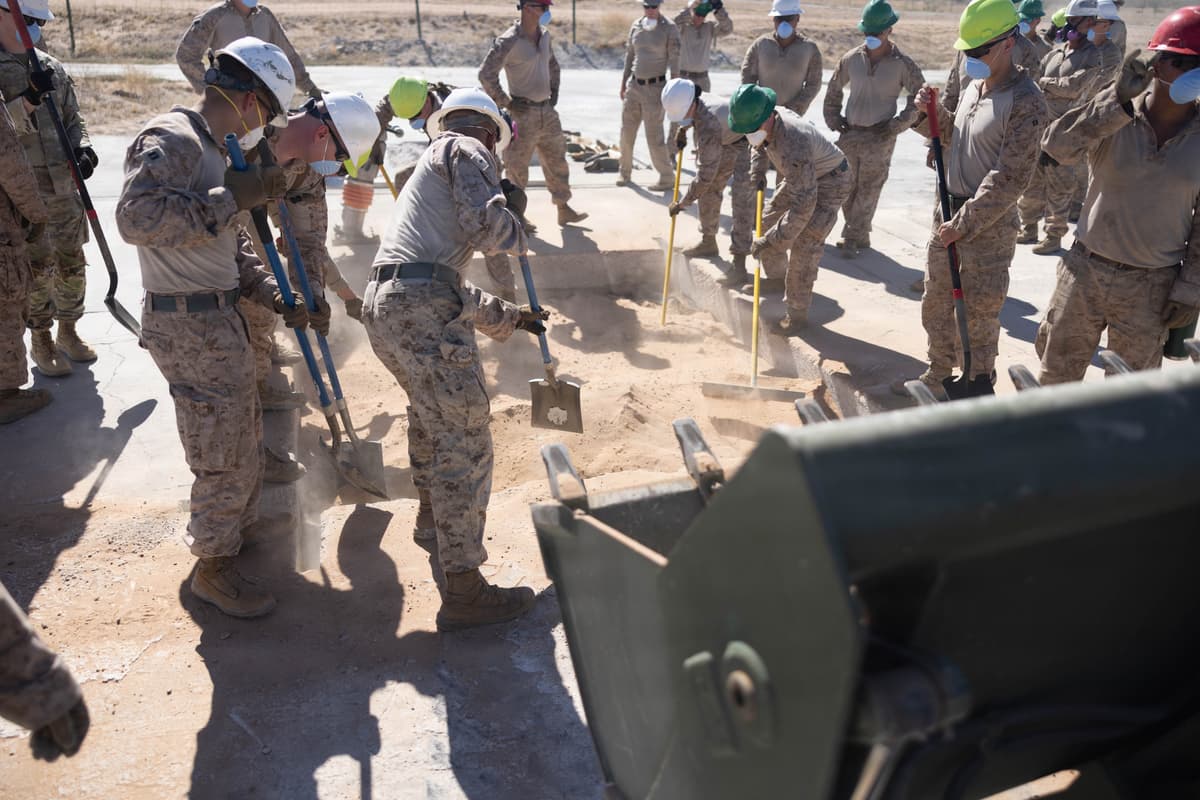
The US Marine Corps Is Looking for a Few Good Robots to Build Airfields
Companies Mentioned


Why It Matters
Automating EAF assembly will dramatically cut manpower and deployment time, enhancing the Marine Corps’ rapid‑response capability and setting a precedent for military construction robotics.
Key Takeaways
- •SBIR targets robots to lay and connect EAF matting autonomously
- •Phase I tests feasibility, payload, precision, and endurance on uneven terrain
- •Phase II aims for a functional prototype with semi‑automated operation
- •Phase III will field‑harden robots against electrical, environmental, cyber threats
- •Success could cut manning, costs, and deployment time for Marine airfields
Pulse Analysis
Expeditionary airfields are critical for projecting power from sea‑based platforms, yet their rapid construction has long relied on physically demanding manual labor. Marines must unroll, align, and bolt heavy aluminum mat sections on sandy or rocky beaches, exposing them to fatigue and hazardous conditions. As the U.S. pivots toward more distributed, resilient force structures, the need for automated solutions that can operate in unpredictable, harsh environments has become a strategic priority for the Department of Defense.
The Marine Corps’ Small Business Innovation Research (SBIR) program outlines a three‑phase roadmap to bring such capability to fruition. Phase I focuses on proving that a mobile manipulator can handle the payload, reach, and precision required to position EAF mats on uneven ground while managing power consumption and endurance. Phase II escalates to a semi‑automated prototype that integrates obstacle avoidance, path planning, and grasping algorithms, reducing human oversight. Finally, Phase III demands a hardened system resilient to electrical, environmental, and cyber threats, ready for field trials that demonstrate measurable reductions in man‑hours, cost, and deployment timelines. This structured approach not only de‑riscos the technology for the military but also creates a clear pathway for commercial robotics firms to adapt their platforms for defense contracts.
If successful, the automated airfield assembly solution could reshape logistics for amphibious operations, enabling faster establishment of forward operating bases and supporting rapid humanitarian or combat missions. The broader implications extend to the construction sector, where similar autonomous mat‑handling technologies could accelerate infrastructure projects in remote or disaster‑affected areas. By marrying military exigencies with cutting‑edge robotics, the Marine Corps is poised to drive innovation that benefits both national security and the civilian economy.
The US Marine Corps is looking for a few good robots to build airfields
Comments
Want to join the conversation?
Loading comments...