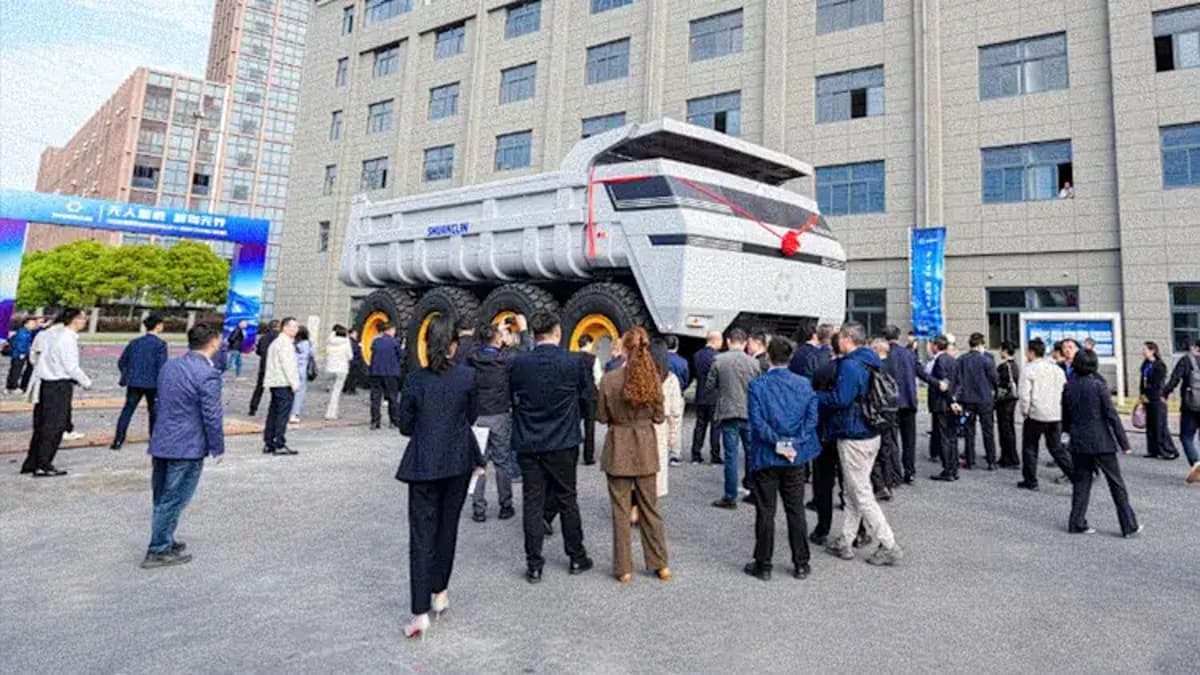
This Driverless Chinese Mining Truck Is Giant, Agile, and Shows the Industrial Future of AI
Companies Mentioned
Why It Matters
Full autonomy could dramatically lower labor costs and accident risk while freeing up valuable road space on mining sites, accelerating the sector’s shift toward digital operations.
Key Takeaways
- •Shuanglin K7 is a 45‑ft long, 110‑ton autonomous mining truck.
- •Level‑4 AI enables 360° rotation and crab‑style lateral movement.
- •Distributed drive‑by‑wire system replaces traditional steel shafts at each wheel.
- •Autonomous operation could cut road‑space needs and improve mine safety.
Pulse Analysis
The Shuanglin K7 represents a bold leap in embodied AI, moving beyond the humanoid prototypes that dominate headlines to a massive, purpose‑built vehicle for the mining sector. At 45.2 feet in length and 18.7 feet wide, the truck weighs 110.2 short tons empty and up to 273.4 tons when loaded. Its Level‑4 autonomous brain processes sensor data in real time, staying within a pre‑mapped excavation zone while detecting obstacles, other equipment, and personnel. The distributed drive‑by‑wire architecture—four independent electric motors at each wheel—delivers unprecedented maneuverability, allowing the truck to pivot on its vertical axis and shift sideways like a crab, eliminating the need for dedicated turning lanes.
While automotive giants such as Volvo, Mercedes and Tesla have rolled out Level‑2 or Level‑3 driver‑assist features, the K7’s Level‑4 capability places it in a distinct class of heavy‑industry automation. The ability to operate continuously without a safety driver promises higher utilization rates and reduced downtime, directly impacting the cost per ton of extracted material. Moreover, the digital nervous system reduces mechanical complexity, potentially lowering maintenance expenses compared with traditional drivetrain designs. However, challenges remain: the system must demonstrate reliability in harsh, dust‑laden environments, and regulatory frameworks for driverless heavy equipment are still evolving.
If the K7 can validate its performance, it could trigger a cascade of adoption across global mining operations, where safety and efficiency are paramount. Operators may reconfigure mine layouts, reclaiming space previously allocated for vehicle turning. Labor dynamics will shift, with a greater emphasis on remote monitoring and AI system management rather than on‑site driving. Investors and equipment manufacturers alike will watch closely, as the successful deployment of such a high‑payload autonomous platform could set a new benchmark for AI‑driven industrial machinery.
This Driverless Chinese Mining Truck Is Giant, Agile, and Shows the Industrial Future of AI
Comments
Want to join the conversation?
Loading comments...