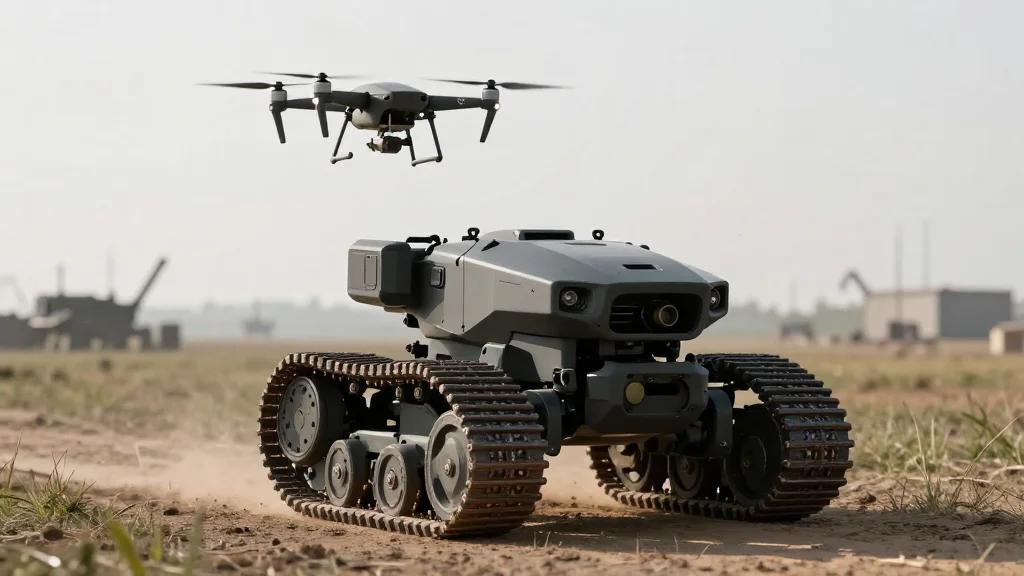
Ukrainian Ground Robots Seize Russian Position, Marking New Era of Autonomous Warfare

Why It Matters
The successful robot‑only seizure demonstrates that autonomous systems can achieve tactical objectives previously thought to require human soldiers. This breakthrough validates years of investment in unmanned ground vehicles and AI‑driven combat software, suggesting that future wars may be fought with far fewer boots on the ground. For defence industries, the Ukrainian case provides a live proof‑of‑concept that could unlock new markets for autonomous platforms, navigation suites and battlefield AI. Beyond the immediate military impact, the development signals a broader shift in how states approach force protection and operational risk. By reducing casualty rates, autonomous systems can sustain prolonged engagements without the political backlash that accompanies high human losses. This dynamic may encourage more aggressive posturing in contested zones, reshaping geopolitical stability in Europe and beyond.
Key Takeaways
- •Ukrainian forces captured a Russian position using only autonomous ground robots and drones
- •Over 22,000 robot‑led front‑line missions were completed in the preceding three months
- •Seven robot models—Ratel, TerMIT, Ardal, Rys, Zmiy, Protector, Volia—were deployed in the operation
- •Ukrainian drones now reach targets up to 1,750 km from the front line
- •The success is prompting NATO allies to accelerate procurement of autonomous combat systems
Pulse Analysis
Ukraine’s robot‑only capture marks a watershed in combat doctrine, proving that unmanned ground systems can replace infantry in high‑risk assaults. Historically, autonomous platforms were relegated to reconnaissance or logistics; this operation pushes them into the decisive kinetic role. The shift is underpinned by a confluence of factors: a mature domestic supply chain, AI‑driven targeting, and the necessity to operate under pervasive electronic‑warfare that degrades GPS signals. As a result, the Ukrainian military has turned a strategic vulnerability—reliance on external hardware—into a competitive advantage.
For the global defence market, the implications are twofold. First, manufacturers that can deliver rugged, software‑centric solutions stand to capture a surge in demand, especially from nations facing similar jamming environments. Second, the operational success may trigger a doctrinal ripple effect, compelling traditional armies to reallocate resources from manpower‑intensive units to autonomous fleets. This reallocation could accelerate the decline of large conscript forces and reshape defence budgeting priorities for the next decade.
Looking forward, the sustainability of Ukraine’s autonomous push will hinge on scaling production, securing supply chains for semiconductors and power systems, and protecting AI algorithms from cyber intrusion. If these challenges are met, autonomous ground combat could become a standard component of modern militaries, fundamentally altering the balance of power on future battlefields.
Ukrainian Ground Robots Seize Russian Position, Marking New Era of Autonomous Warfare
Comments
Want to join the conversation?
Loading comments...