Autonomy News and Headlines
  • All Technology
  • AI
  • Autonomy
  • B2B Growth
  • Big Data
  • BioTech
  • ClimateTech
  • Consumer Tech
  • Crypto
  • Cybersecurity
  • DevOps
  • Digital Marketing
  • Ecommerce
  • EdTech
  • Enterprise
  • FinTech
  • GovTech
  • Hardware
  • HealthTech
  • HRTech
  • LegalTech
  • Nanotech
  • PropTech
  • Quantum
  • Robotics
  • SaaS
  • SpaceTech
AllNewsDealsSocialBlogsVideosPodcastsDigests

Autonomy Pulse

EMAIL DIGESTS

Daily

Every morning

Weekly

Sunday recap

NewsDealsSocialBlogsVideosPodcasts
AutonomyNewsUS Army to Debut FPV Bumblebee V2 Drone Interceptor Next Month
US Army to Debut FPV Bumblebee V2 Drone Interceptor Next Month
AutonomyDefense

US Army to Debut FPV Bumblebee V2 Drone Interceptor Next Month

•February 13, 2026
0
Defense News – Unmanned
Defense News – Unmanned•Feb 13, 2026

Why It Matters

It gives troops a low‑collateral, cost‑effective counter‑UAS capability, strengthening force protection as drone threats multiply.

Key Takeaways

  • •$5.2 M contract funds Bumblebee V2 deliveries.
  • •AI‑driven quadcopter physically collides with hostile drones.
  • •Kinetic “hard kill” avoids explosive debris, safe for cities.
  • •NDAA‑compliant, ready for rapid military adoption.
  • •Tested at Fort Bragg’s Joint Innovation Outpost.

Pulse Analysis

The proliferation of small commercial and hostile unmanned aerial systems has become a defining challenge for modern militaries. Traditional counter‑UAS solutions rely on jamming, directed‑energy weapons, or explosive projectiles, each with logistical or collateral drawbacks. Enter the Bumblebee V2, a first‑person‑view quadcopter equipped with proprietary artificial‑intelligence algorithms that can autonomously locate, track, and intercept enemy drones. Rather than firing a missile, the interceptor executes a controlled collision, delivering a kinetic “hard kill” that neutralizes the target instantly. This approach aligns with the Army’s push for agile, low‑cost solutions that can be fielded quickly.

The kinetic nature of the Bumblebee V2 eliminates the blast radius and shrapnel associated with conventional munitions, making it especially suitable for dense urban environments where civilian infrastructure is at risk. Its four‑rotor design provides the maneuverability needed to engage fast‑moving quadcopters and fixed‑wing UAVs alike. Because the system contains only domestically sourced components, it satisfies the National Defense Authorization Act’s strict foreign‑part restriction, streamlining procurement and reducing compliance hurdles. At a $5.2 million contract price, the interceptor promises a cost‑effective alternative to expensive laser or missile systems.

The Army’s Global Response Force will begin operational assessments at Fort Bragg’s newly inaugurated Joint Innovation Outpost, a hub that blends soldier expertise with academic research and private‑sector innovation. Successful trials could accelerate deployment across other branches, reinforcing the United States’ layered counter‑UAS architecture. Moreover, the Bumblebee V2’s modular software stack opens the door for future upgrades, such as swarming capabilities or integration with battlefield networks. As adversaries continue to field increasingly sophisticated drones, kinetic interceptors like Bumblebee V2 are poised to become a cornerstone of force protection and battlefield lethality.

US Army to debut FPV Bumblebee V2 drone interceptor next month

The U.S. Army’s Global Response Force will begin assessing the Bumblebee V2 drone interceptor in March following a $5.2 million contract award inked on January 30 by the Pentagon.

The Defense Department’s Joint Interagency Task Force 401 announced the agreement with Perennial Autonomy on February 4, which will see deliveries of the Bumblebee V2 start next month.

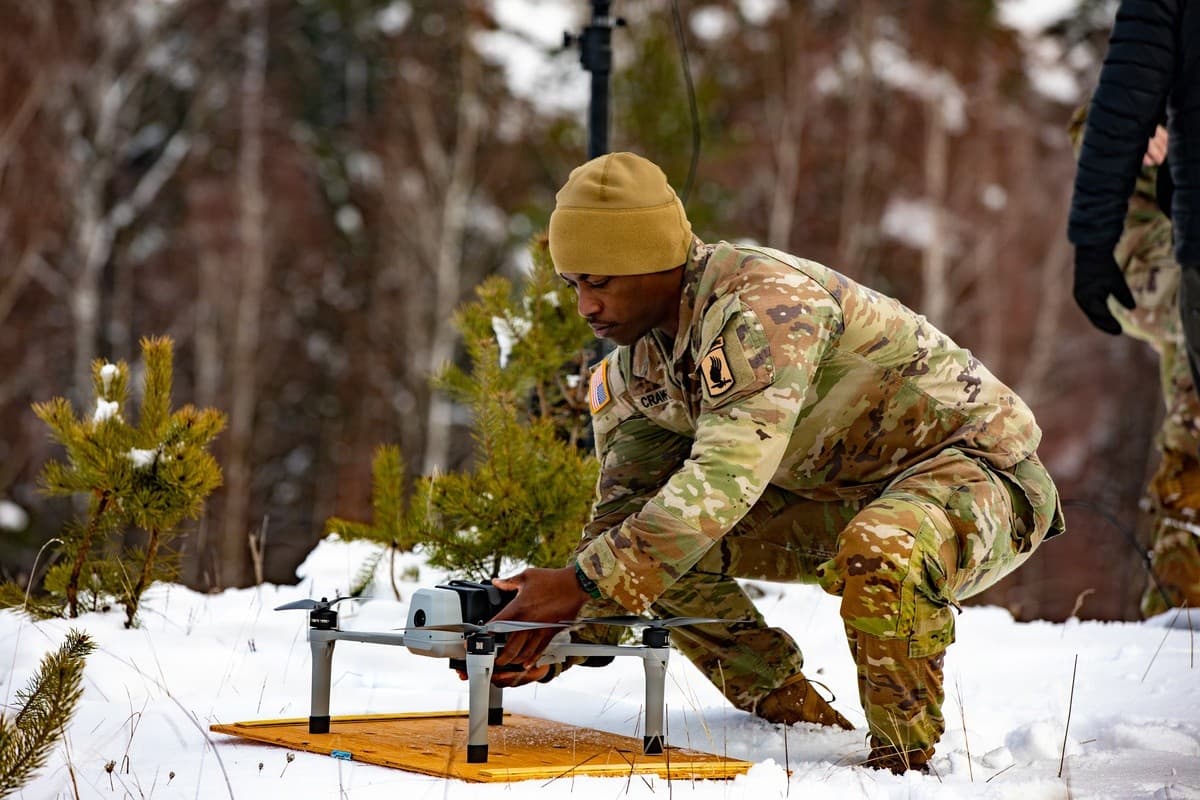
The Bumblebee V2, a first-person view drone with four rotors, acts as its own drone hunter-killer system. Advanced artificial intelligence software enables it to identify other unmanned aerial vehicles and engage them in combat. It attacks other drones and knocks them out of the sky with a direct physical collision.

“This decision puts kinetic counter-small UAS capability into the hands of our troops immediately,” Army Brig. Gen. Matthew Ross, JIATF-401 director, said in a statement.

“The Bumblebee V2 provides a cost-effective, reliable interceptor that can neutralize threats without endangering our own forces or surrounding infrastructure. On the modern battlefield, where drones are a constant threat, having a low-collateral kinetic option is not just an advantage; it is increasingly becoming essential for protecting our forces.”

Direct physical strikes on unmanned aerial vehicles, known as “hard kills,” can produce a blast radius and scatter sharp debris when munitions are used.

With a drone-on-drone strike, the Bumblebee minimizes these risks. Having one flying drone tackle another eliminates the need for bullets and potentially harmful explosions. This potential could see the Bumblebee used efficiently in urban areas.

Additionally, the system is compliant with updated regulations in the National Defense Authorization Act, which has strict requirements for the use of foreign components. Drones with NDAA compliance, such as the HANX drone developed by the U.S. Marines, can be adopted for military use with immediate effect.

The Army’s Global Response Force will assess the system in support of the Lt. Gen. James M. Gavin Joint Innovation Outpost, a new facility opened at Fort Bragg on Jan. 3 to bring together soldiers, academics and private industry to develop and test new technology.

Read Original Article
0

Comments

Want to join the conversation?

Loading comments...