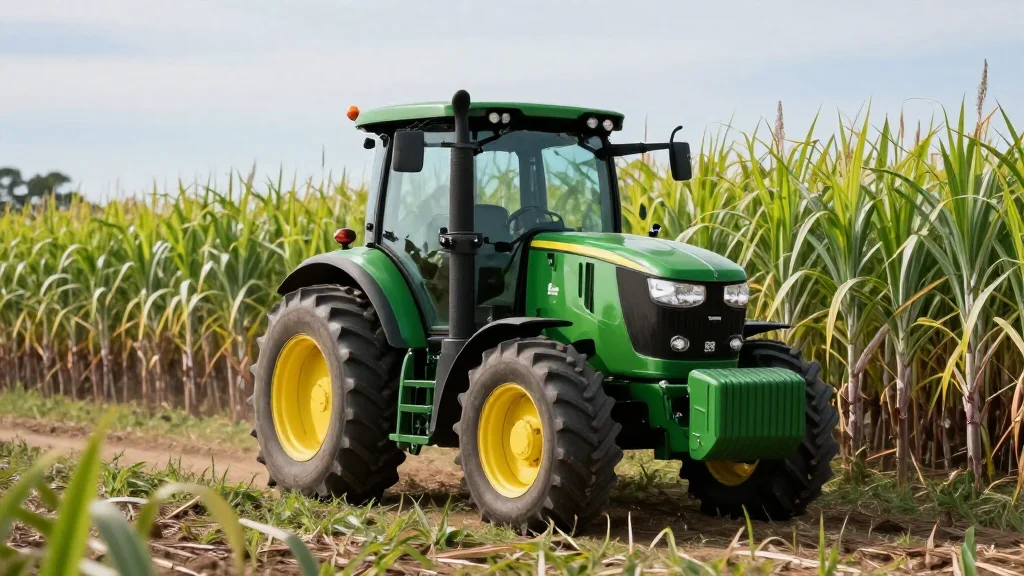
U.S. Sugar Deploys Largest Autonomous Tractor Fleet in American Sugar Farming

Companies Mentioned
Why It Matters
The deployment of autonomous tractors by a major processor like U.S. Sugar demonstrates that driverless technology is moving from experimental pilots to large‑scale commercial use in a core U.S. commodity. By automating labor‑intensive tasks such as field preparation, the company can mitigate chronic labor shortages, reduce operational costs, and improve yield consistency—factors that directly affect the price and availability of sugar for consumers. Moreover, the initiative showcases a domestic supply chain for autonomy, from John Deere hardware to ASI software, reinforcing U.S. leadership in agri‑tech innovation. Beyond sugar, the success of this fleet could accelerate adoption across other high‑volume crops, prompting equipment manufacturers and software firms to double down on autonomous solutions. The retraining component also highlights a pathway for preserving jobs while upgrading skill sets, addressing a common criticism that automation will simply displace workers.
Key Takeaways
- •U.S. Sugar launches five autonomous John Deere tractors on 255,000 acres of South Florida sugarcane fields.
- •Fleet includes four 8R Series and one 9R Series tractors operating 24/7 under ASI’s Mobius platform.
- •Technology resulted from an 18‑month R&D partnership between U.S. Sugar and Autonomous Solutions, Inc.
- •Company will retrain existing staff for higher‑skill roles as part of the automation rollout.
- •U.S. Sugar purchased the tractors from Everglades Equipment Group, signaling a domestic supply chain for autonomous farm equipment.
Pulse Analysis
U.S. Sugar’s autonomous tractor rollout is a watershed moment for large‑scale commodity farming, where the economics of scale have historically favored manual labor and conventional machinery. By committing to a fleet that can run continuously, the company is betting that the marginal gains in field efficiency will outweigh the capital outlay for driverless hardware and software. Early data from similar pilots in the Midwest suggest yield improvements of 3‑5% and fuel savings of up to 12%, figures that could translate into multi‑million‑dollar profit lifts for a processor handling over a quarter‑million acres.
The strategic choice to partner with John Deere and a Utah‑based software firm also reflects a broader shift toward vertically integrated solutions. Rather than relying on fragmented third‑party add‑ons, U.S. Sugar is building a closed loop where equipment, data, and analytics are tightly coupled. This integration reduces latency in decision‑making, enabling real‑time adjustments to planting depth, row spacing, and even pest management. Competitors that continue to rely on legacy equipment may find themselves at a cost disadvantage as autonomous platforms become the new benchmark for operational efficiency.
Looking forward, the key risk lies in scaling the technology beyond the pilot phase. Autonomous tractors must prove resilience against South Florida’s high humidity, sudden storms, and the corrosive environment of sugarcane fields. Regulatory approval for unmanned heavy equipment on public roads and private property will also shape the speed of adoption. If U.S. Sugar can navigate these hurdles, it will not only secure a more reliable domestic sugar supply but also set a template for other staple crops, potentially reshaping the entire U.S. agricultural automation landscape.
U.S. Sugar Deploys Largest Autonomous Tractor Fleet in American Sugar Farming
Comments
Want to join the conversation?
Loading comments...