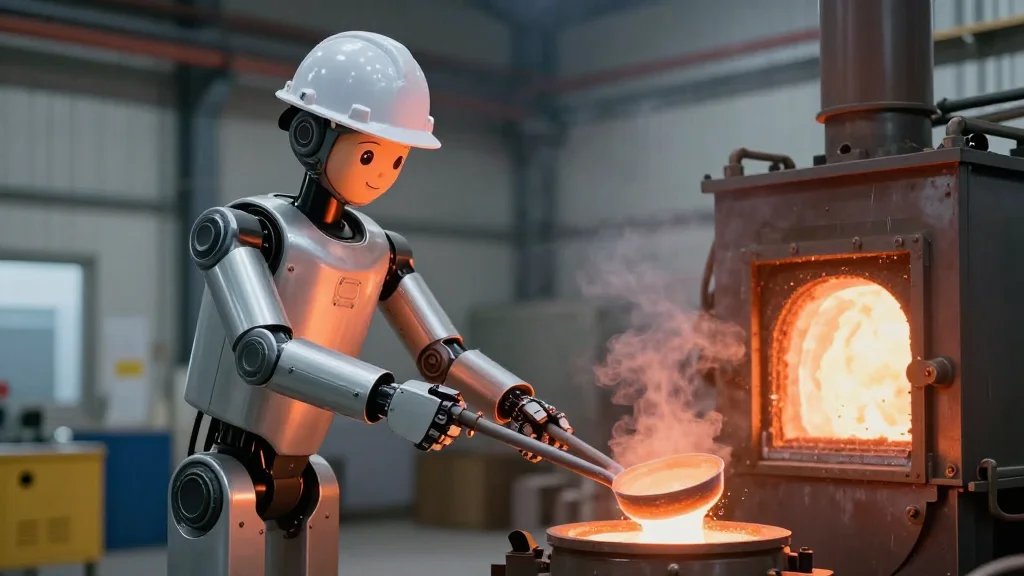
Vedanta Aluminium Launches AI Humanoid ALAISA at BALCO, Training 100+ Staff

Why It Matters
Deploying an autonomous humanoid robot in a core manufacturing setting demonstrates that AI can move beyond data‑center analytics to direct, on‑site interaction with human workers. For the aluminium sector, where safety and process consistency are paramount, ALAISA offers a repeatable method to disseminate best practices and reduce reliance on scarce senior technicians. The initiative also showcases how Indian conglomerates can leverage AI to close skill gaps, a challenge that has long constrained productivity in the country’s heavy‑industry base. If ALAISA delivers measurable improvements, it could trigger a wave of similar deployments across other metal producers, cementing India’s position as a testing ground for industrial autonomy. The broader ripple effect may include faster adoption of AI‑driven safety protocols, reduced downtime, and a new benchmark for workforce training that blends digital and physical instruction.
Key Takeaways
- •Vedanta Aluminium introduced the AI humanoid ALAISA at BALCO's smelter.
- •The robot has already trained more than 100 shop‑floor employees.
- •ALAISA provides real‑time procedural guidance, maintenance advice and safety alerts.
- •The deployment builds on Vedanta's existing predictive analytics and IoT monitoring across hundreds of machines.
- •Success could accelerate humanoid AI adoption across India's aluminium and broader metals industry.
Pulse Analysis
Vedanta's ALAISA pilot marks a strategic inflection point where autonomous agents transition from peripheral monitoring tools to frontline educators. Historically, industrial AI in India has focused on predictive maintenance and process optimisation; the shift to a humanoid interface addresses a deeper bottleneck—knowledge transfer at scale. By embedding conversational AI directly on the shop floor, Vedanta sidesteps the latency and cultural resistance often associated with centralized training programs.
From a competitive standpoint, the move gives Vedanta a potential cost advantage. Training hundreds of operators through a single robot reduces the need for recurring instructor fees and travel logistics, while the data captured during interactions can feed back into continuous improvement loops. If the pilot demonstrates reductions in safety incidents or equipment failures, the ROI could be compelling enough to justify broader capital allocation toward similar deployments.
Looking forward, the key challenge will be integration depth. ALAISA must not only answer static queries but also adapt to evolving plant conditions and regulatory changes. Success will hinge on the robustness of its underlying language models, the fidelity of real‑time data feeds, and the willingness of workers to trust an autonomous system. Should these hurdles be overcome, the aluminium sector could become a showcase for autonomous humanoid assistants, prompting downstream industries—steel, cement, petrochemicals—to explore comparable solutions. The next six months will be critical as Vedanta publishes performance metrics, and the industry gauges whether the ALAISA model is scalable beyond a single pilot site.
Vedanta Aluminium launches AI humanoid ALAISA at BALCO, training 100+ staff
Comments
Want to join the conversation?
Loading comments...