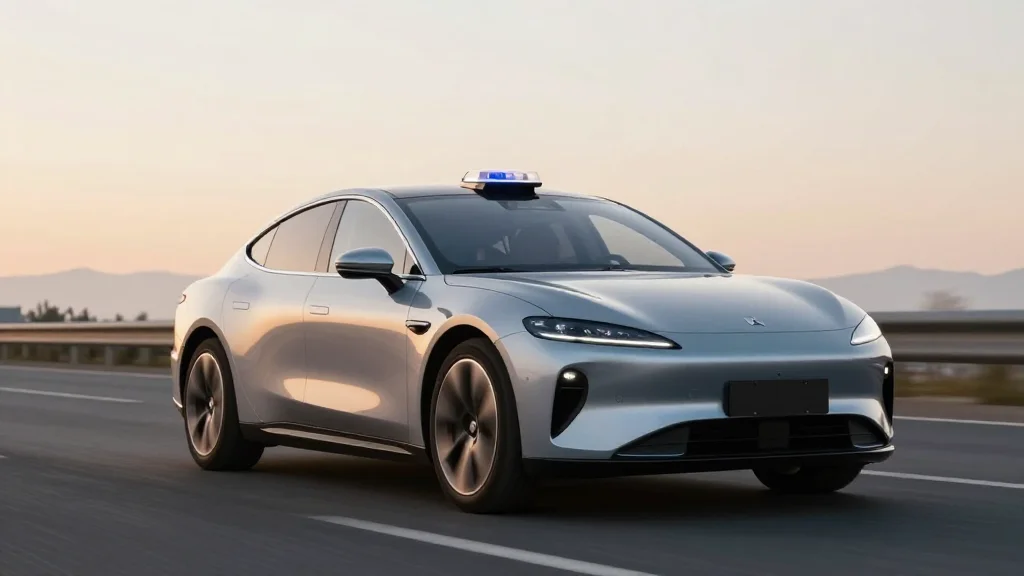
Wayve Teams with Stellantis to Deploy Hands-Free Driving in U.S. Cars by 2028

Companies Mentioned
Why It Matters
The Wayve‑Stellantis partnership could democratize advanced driver‑assist features by bringing AI‑driven hands‑free capability to a broad portfolio of mass‑market vehicles. By leveraging a sensor‑agnostic neural network, the collaboration sidesteps the costly mapping and hardware lock‑ins that have limited the scalability of many autonomous solutions. If the 2028 rollout proves successful, it may set a new benchmark for how quickly AI can be deployed across diverse vehicle lines, pressuring rivals to adopt similarly flexible architectures. Furthermore, the deal illustrates how legacy automakers are increasingly turning to specialist AI firms to accelerate their autonomy roadmaps. Stellantis’s investment in Wayve and the subsequent commercial agreement signal a willingness to outsource core perception and decision‑making functions, allowing the automaker to focus on integration, safety validation, and regulatory compliance. This model could become a template for other OEMs seeking to balance in‑house engineering with external innovation.
Key Takeaways
- •Wayve and Stellantis sign a commercial agreement to integrate Wayve’s AI driving stack into U.S. models, targeting 2028 launch.
- •Partnership builds on Stellantis’s strategic investment in Wayve and follows Wayve’s $1.2 billion Series D round.
- •Initial focus is a Level 2++ hands‑free system running on Stellantis’s STLA AutoDrive platform.
- •Wayve’s sensor‑agnostic, end‑to‑end neural network can generalize across Stellantis’s 14 brands and vehicle types.
- •First pilot integration slated for 2028; subsequent rollout will leverage Stellantis’s $70 billion turnaround plan.
Pulse Analysis
Wayve’s collaboration with Stellantis marks a pivotal moment in the convergence of AI‑first autonomy startups and legacy OEMs. Historically, automakers have built proprietary stacks that tie software to specific sensor suites and high‑definition maps, creating costly upgrade paths and limiting cross‑model reuse. Wayve’s approach—training a single neural network on raw sensor data regardless of hardware—offers a modular alternative that can be deployed across a heterogeneous fleet with minimal re‑engineering. This flexibility aligns perfectly with Stellantis’s portfolio, which spans everything from compact cars to full‑size trucks, and could enable the automaker to spread development costs over a larger volume base.
From a competitive standpoint, the partnership puts Stellantis ahead of several rivals that are still experimenting with bespoke solutions. Tesla’s Full Self‑Driving (FSD) remains tightly coupled to its own hardware and map ecosystem, while other incumbents like Ford and GM are investing heavily in lidar‑centric architectures. Wayve’s sensor‑agnostic model may allow Stellantis to offer comparable hands‑free functionality at a lower price point, especially as the company plans to launch multiple sub‑$40,000 models in North America. The ability to retrofit existing platforms with a software‑only upgrade could also accelerate adoption across older vehicle generations.
Looking forward, the success of the 2028 pilot will hinge on regulatory acceptance of Level 2++ systems and the ability to demonstrate safety at scale. Wayve’s promise of continuous learning from real‑world data could provide a feedback loop that improves performance faster than traditional rule‑based systems. However, the partnership also raises questions about data ownership, liability, and the long‑term roadmap toward higher levels of autonomy. If Wayve and Stellantis can navigate these challenges, the collaboration could become a blueprint for how the industry scales AI‑driven autonomy without the massive capital outlays traditionally required.
Wayve Teams with Stellantis to Deploy Hands-Free Driving in U.S. Cars by 2028
Comments
Want to join the conversation?
Loading comments...