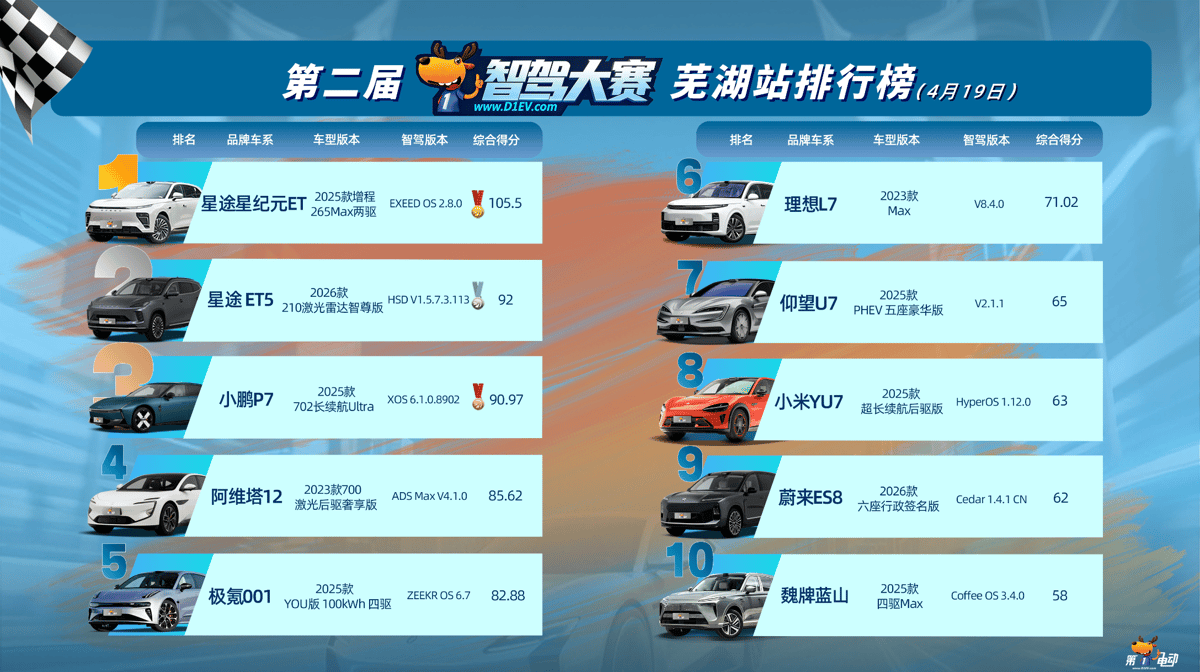
WRD 3.0 Secures Fourth Consecutive Win in China’s Urban Intelligent Driving Competition
Why It Matters
The streak reinforces WRD 3.0’s leadership in urban autonomous driving, boosting WeRide’s credibility with OEMs and accelerating adoption of high‑definition ADAS in China’s fast‑growing market.
Key Takeaways
- •WRD 3.0 took first at Wuhu round, beating rivals by >10 points.
- •Solution merges WeRide’s Genesis simulation with Bosch’s end‑to‑end ADAS hardware.
- •Closed‑loop training ties real‑world mileage to large‑scale L4 simulation.
- •Four consecutive wins cement WRD 3.0 as China’s top urban driverless system.
Pulse Analysis
The China Urban Intelligent Driving Competition has become a benchmark for evaluating real‑world readiness of autonomous technologies. This year’s Wuhu round, hosted by D1EV, featured a field of heavyweight contenders, yet the Chery Exeed Sterra ET equipped with WeRide’s WRD 3.0 outperformed Horizon Robotics and XPeng by a decisive margin. The competition’s scoring emphasizes not only lane‑keeping precision but also complex urban interactions such as pedestrian navigation and unstructured road conditions, making the victory a strong validation of the platform’s robustness.
At the core of WRD 3.0’s advantage is its Genesis simulation engine, which ingests billions of kilometers of Level‑4 driverless data to recreate intricate city scenarios at scale. By feeding real‑world driving logs into a high‑fidelity virtual environment, engineers can iterate on perception, planning, and control modules far faster than on‑road testing alone permits. This closed‑loop methodology ensures that each additional mile logged on public streets directly enriches the simulation corpus, sharpening the system’s ability to generalize across diverse traffic patterns and weather conditions.
The win carries strategic weight for both WeRide and its partner Bosch. Demonstrated success in a high‑visibility contest accelerates OEM confidence, potentially unlocking new contracts with Chinese manufacturers eager to embed advanced ADAS across their lineups. Moreover, the partnership showcases a viable path for Western sensor and software firms to collaborate with domestic AI specialists, a model likely to shape the next wave of autonomous deployments across Asia’s megacities. As urban mobility regulations tighten, platforms that can prove safety and scalability through competitive benchmarks will dominate the market.
WRD 3.0 secures fourth consecutive win in China’s Urban Intelligent Driving Competition
Comments
Want to join the conversation?
Loading comments...