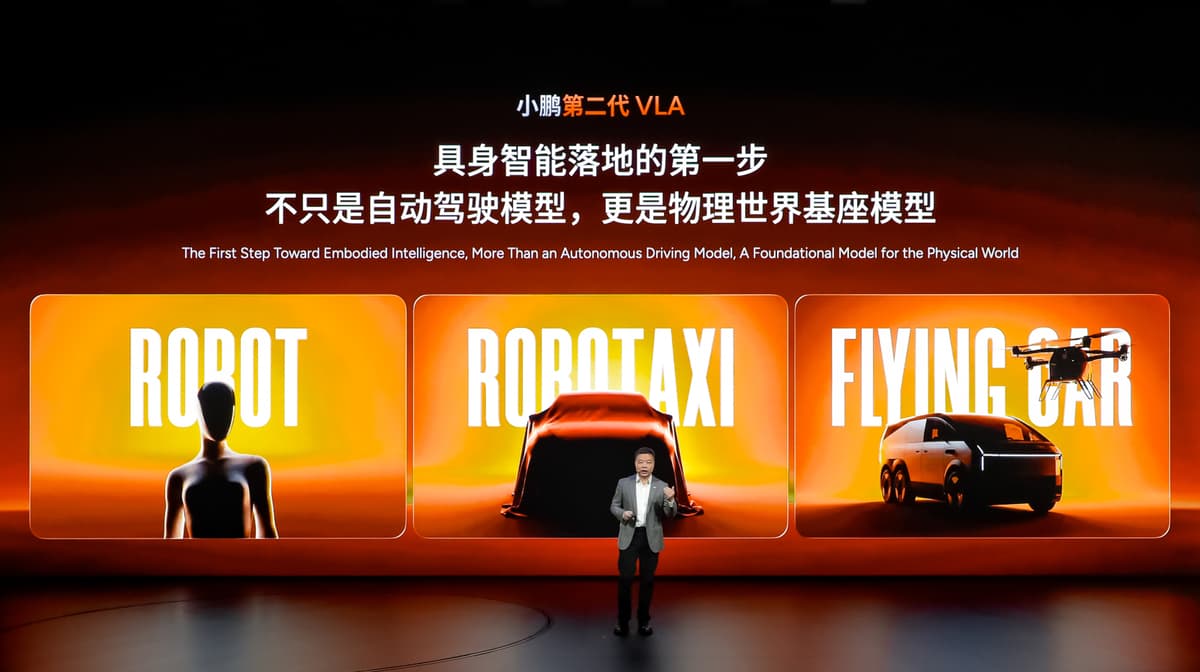
XPeng to Deploy Second-Generation AI-Driven Autonomous Driving System by 2027
•March 3, 2026
0
Why It Matters
VLA 2.0 accelerates XPeng’s competitive edge in autonomous driving, potentially reshaping market dynamics as AI‑based vehicles scale globally. The partnership with Volkswagen and European OTA updates broaden its ecosystem reach.
Key Takeaways
- •VLA 2.0 launches globally in 2027.
- •Volkswagen partners for Chinese market debut.
- •End-to-end vision-to-action replaces language layer.
- •XOS 5.8.7 OTA update rolls out Europe.
- •XPeng showcases architecture in Amsterdam event.
Pulse Analysis
Autonomous driving has entered a pivotal phase as Chinese manufacturers invest heavily in artificial‑intelligence platforms. XPeng’s announcement of VLA 2.0 marks the company’s most ambitious leap since its first generation system, promising a fully integrated perception‑to‑control stack that can be deployed across continents. By targeting a 2027 global rollout, XPeng aligns its timeline with major regulatory windows in Europe and North America, positioning itself to capture market share before many legacy automakers finalize their own AI solutions. The rollout also aligns with XPeng’s broader strategy to monetize data services across its fleet.
The core innovation of VLA 2.0 lies in its end‑to‑end vision‑to‑action architecture. Traditional pipelines translate camera data into language descriptors before generating driving commands, a process that adds latency and error propagation. By removing the intermediate language layer, XPeng’s system can react faster and learn directly from visual inputs, improving decision accuracy in complex traffic scenarios. This approach mirrors trends seen in leading research labs, where transformer‑based models process raw sensor streams, suggesting XPeng is adopting cutting‑edge AI methodologies ahead of most competitors. Early field tests have shown a 15% reduction in reaction latency compared with VLA 1.0.
Strategically, the partnership with Volkswagen gives VLA 2.0 immediate credibility in the Chinese market, while the XOS 5.8.7 OTA update demonstrates XPeng’s commitment to software continuity in Europe. These moves create a dual‑track ecosystem that blends hardware excellence with rapid, over‑the‑air enhancements, a combination increasingly demanded by regulators and consumers alike. If XPeng can scale VLA 2.0 reliably, it could pressure rivals such as Tesla and Baidu to accelerate their own AI stacks, potentially reshaping the global autonomous‑vehicle landscape. Analysts project that VLA 2.0 could add $1.2 billion in revenue by 2030.
XPeng to deploy second-generation AI-driven autonomous driving system by 2027
0
Comments
Want to join the conversation?
Loading comments...