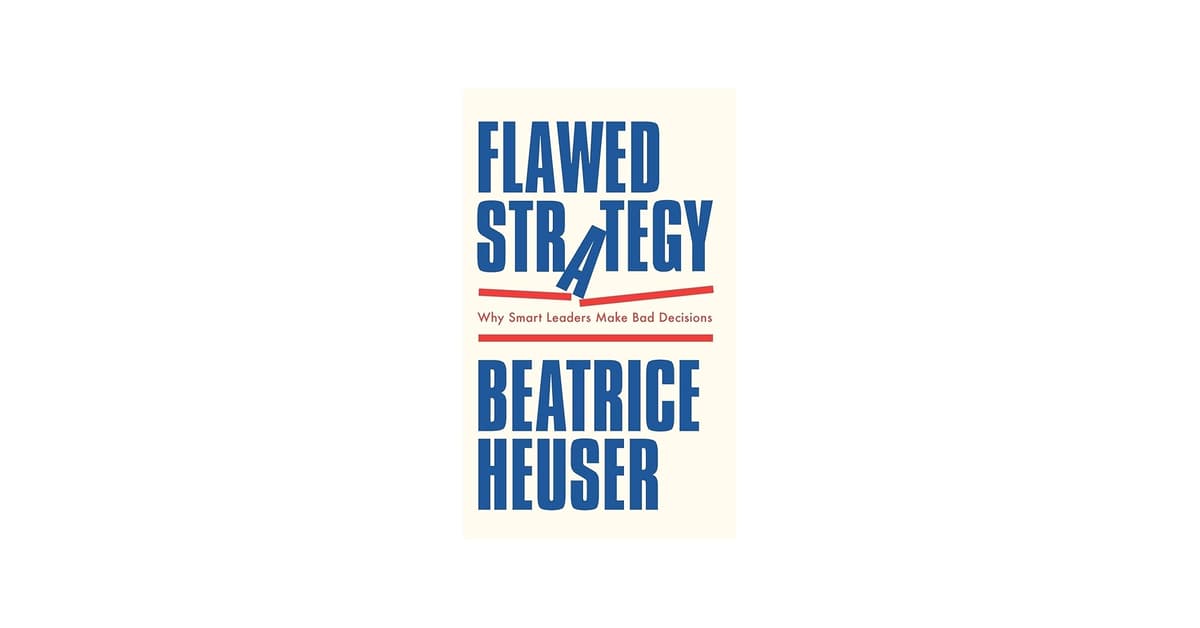
Book Review | Flawed Strategy: Why Smart Leaders Make Bad Decisions
Key Takeaways
- •Heuser argues rational actor model oversimplifies state behavior
- •Identifies confirmation, anchoring, and materialism biases in security analysis
- •Uses Russia‑Ukraine war to illustrate flawed cost‑benefit assumptions
- •Offers actionable guidance for junior strategists to avoid decision traps
- •Senior professionals may find the book repetitive and overly historical
Pulse Analysis
*Flawed Strategy* arrives at a moment when the limits of traditional strategic theory are under intense scrutiny. Heuser, a professor at the Free University of Brussels, leverages her background in military history to argue that the rational‑actor model—long a staple of international‑relations curricula—fails to capture the ideological motivations that drive states like Russia and, increasingly, China. By juxtaposing the predictable‑cost framework with the reality of Putin’s declared belief that Ukraine belongs to Russia, she demonstrates how overlooking belief systems leads to costly intelligence failures. This critique resonates across the security community, where analysts are urged to move beyond materialist calculations and incorporate cultural narratives into threat assessments.
The second pillar of Heuser’s analysis focuses on cognitive biases that pervade policy circles. Confirmation bias and anchoring bias, well‑documented in psychology, are shown to skew threat perception, while a newly coined "materialism bias" describes Western analysts’ overreliance on economic costs at the expense of ideological drivers. The book’s discussion of these biases is especially pertinent for U.S. planners evaluating China’s "national rejuvenation" agenda, where ideological imperatives may outweigh conventional cost‑benefit logic. By exposing these blind spots, Heuser equips junior analysts with a checklist to interrogate their own assumptions before formulating strategy.
From a pedagogical standpoint, *Flawed Strategy* serves as a bridge between academic theory and practical application. Its historical case studies provide concrete illustrations for classroom debate, while the concluding guidance chapter offers a concise playbook for avoiding strategic missteps. However, the heavy reliance on historical anecdotes can dilute the central argument for seasoned practitioners seeking fresh frameworks. Nonetheless, the book’s interdisciplinary approach—melding history, psychology, and strategic studies—makes it a valuable addition to curricula aimed at cultivating the next generation of nuanced, bias‑aware security leaders.
Book Review | Flawed Strategy: Why Smart Leaders Make Bad Decisions
Comments
Want to join the conversation?