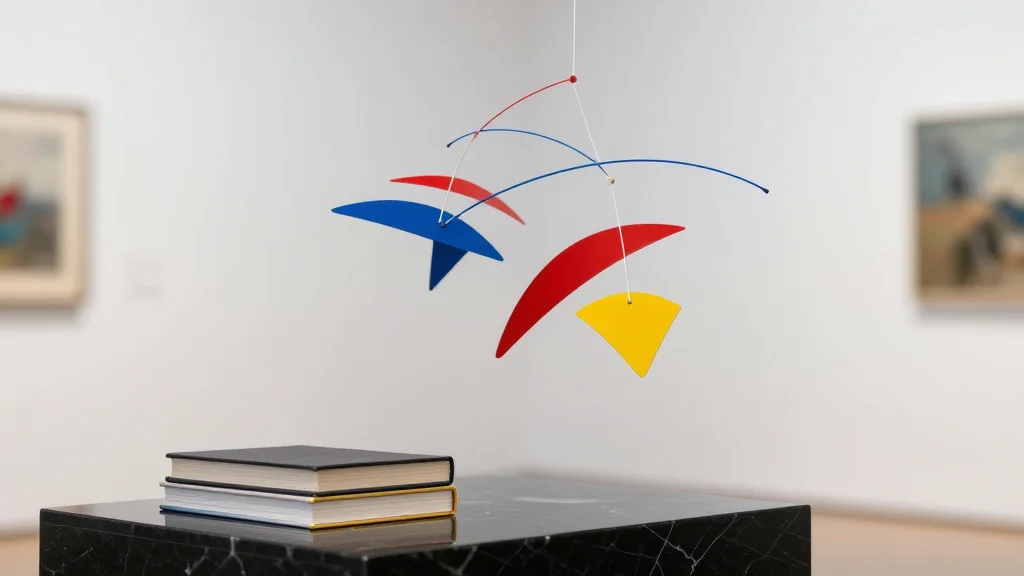
An Expert's Guide to Alexander Calder: Six Must-Read Books on the US Sculptor
Why It Matters
The combined exhibition and bibliography provide a comprehensive gateway for collectors, scholars, and educators to engage with Calder’s legacy, influencing market interest and academic discourse. By spotlighting both rigorous research and accessible narratives, the initiative broadens Calder’s relevance across generations.
Key Takeaways
- •Exhibition showcases 300 Calder works in Paris.
- •Jed Perl volumes provide exhaustive archival research.
- •Calder's autobiography offers rare personal photographs.
- •Calder/Miró explores dialogue with Joan Miró.
- •Sandy’s Circus introduces Calder to young readers.
Pulse Analysis
Alexander Calder remains a cornerstone of 20th‑century modernism, celebrated for transforming kinetic sculpture into a language of balance and motion. The Fondation Louis Vuitton’s spring‑summer showcase not only reunites a vast array of his mobiles, stabiles, and lesser‑known pieces, but also situates his work within the broader narrative of post‑war artistic innovation. By presenting the pieces chronologically, the exhibition reveals how Calder’s engineering precision intersected with his playful imagination, reinforcing his status as a visionary who reshaped public and private spaces.
The accompanying six‑book program deepens that narrative. Jed Perl’s two‑volume set, "The Conquest of Time" and "The Conquest of Space," draws on unprecedented archival material to map Calder’s transatlantic networks and modernist influences. Calder’s own autobiography supplies intimate visual documentation, while the "Calder/Miró" catalogue uncovers a fruitful dialogue with the Spanish surrealist, highlighting shared spatial concepts. "Performing Sculpture" examines the theatrical dimension of his wire works, and Tanya Lee Stone’s "Sandy’s Circus" translates his inventive spirit into a child‑friendly format, ensuring the artist’s story reaches diverse audiences.
For the art market and academic community, this dual approach fuels renewed interest and research opportunities. Collectors gain fresh provenance insights, potentially affecting valuation of Calder pieces, while educators acquire a curated syllabus that bridges scholarly depth and accessibility. The initiative also sets a precedent for future museum collaborations that pair immersive exhibitions with targeted literary resources, fostering a holistic appreciation of artistic legacies.
An expert's guide to Alexander Calder: six must-read books on the US sculptor
Comments
Want to join the conversation?
Loading comments...