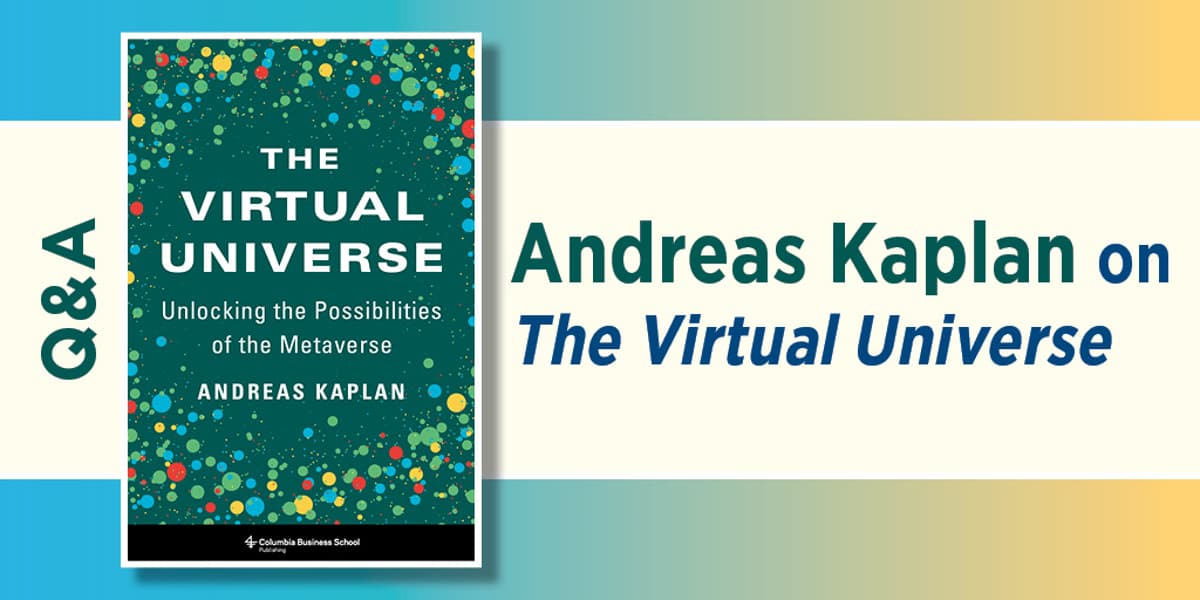
Andreas Kaplan on The Virtual Universe
Why It Matters
The insights signal a shift toward immersive, AI‑augmented learning that could redefine university curricula and create new business opportunities in ed‑tech and corporate training.
Key Takeaways
- •Kaplan defines the Metaverse as an immersive, independent, interconnected social universe
- •ASU, INSEAD, and IE embed VR directly into credit‑bearing courses
- •AI avatars may handle routine instruction, freeing professors for mentorship
- •Virtual simulations enable performance‑based assessment of soft‑skill competencies
Pulse Analysis
The interview with Andreas Kaplan arrives at a pivotal moment as the Metaverse resurfaces after years of hype cycles. By framing the virtual universe as an "immersive, independent, and interconnected" social space, Kaplan offers a clear definition that helps businesses and educators cut through speculative noise. His perspective bridges the gap between technology‑centric narratives and practical applications, highlighting how sectors ranging from supply‑chain management to healthcare can leverage virtual environments for training, scenario planning, and customer engagement. This holistic view is especially valuable for firms seeking to invest in metaverse platforms with measurable ROI.
In higher education, Kaplan points to a small but growing cohort of institutions that have transitioned from experimental pilots to strategic integration of virtual reality. Arizona State University’s credit‑bearing VR courses, INSEAD’s long‑standing virtual‑world initiatives, and IE University’s dedicated Metaverse programs illustrate how immersive tech can become a core pedagogical tool. The key differentiator is institutional commitment: faculty development, curriculum alignment, and outcome‑based assessment ensure that VR enhances learning rather than serving as a novelty. For university leaders, these case studies provide a roadmap for scaling immersive experiences without sacrificing academic rigor.
Looking ahead, Kaplan warns that AI‑driven avatars will likely assume routine instructional tasks, reshaping the professor’s role toward mentorship, critical inquiry, and soft‑skill cultivation. This shift mirrors broader trends in digital transformation where automation handles repetitive processes, freeing human talent for higher‑order functions. As companies and universities adopt AI‑enabled virtual simulations to assess adaptability and resilience, the demand for platforms that blend immersive environments with adaptive learning analytics will surge. Stakeholders who anticipate this convergence can position themselves at the forefront of the next wave of educational and corporate innovation.
Andreas Kaplan on The Virtual Universe
Comments
Want to join the conversation?
Loading comments...