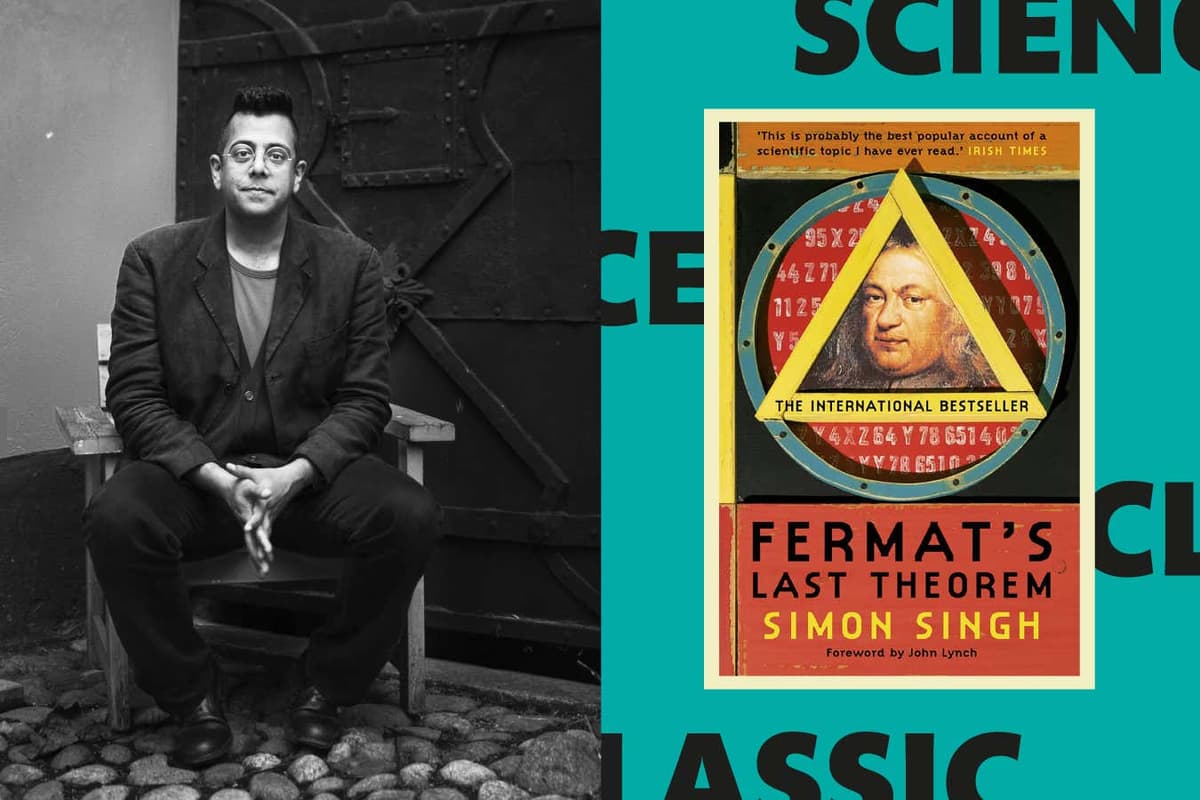
Fermat's Last Theorem: Still a Must-Read About a 350-Year Maths Secret
Why It Matters
The book bridges the gap between complex mathematics and public understanding, inspiring new generations to engage with abstract problem‑solving and reinforcing the cultural value of scientific storytelling.
Key Takeaways
- •Singh's 1997 book demystifies Fermat's proof for lay readers
- •The narrative intertwines mathematical concepts with human drama
- •Decades later, it remains a gateway to advanced math
- •Highlights the 350‑year journey from conjecture to proof
- •Encourages curiosity about abstract reasoning beyond classroom walls
Pulse Analysis
First posed in 1637 by Pierre de Fermat, the eponymous theorem claimed that no three positive integers satisfy aⁿ + bⁿ = cⁿ for n > 2. The conjecture survived centuries of failed attempts, becoming a touchstone for number theory. It was finally resolved in 1994 when British mathematician Andrew Wiles, building on the modularity theorem, produced a proof that spanned hundreds of pages and introduced new techniques in algebraic geometry. The breakthrough not only settled a long‑standing puzzle but also opened fresh research avenues across arithmetic geometry and cryptography.
Simon Singh’s 1997 book transformed this abstract saga into a narrative that any educated reader could follow. By interweaving biographical sketches of figures such as Euler, Gauss, and Wiles with clear explanations of modular forms and elliptic curves, Singh demystifies the underlying mathematics without sacrificing rigor. His storytelling emphasizes the perseverance, rivalry, and occasional serendipity that drive scientific discovery, making the book a template for effective science communication. Educators have long used it to illustrate how a single problem can shape entire fields.
More than thirty years after publication, *Fermat’s Last Theorem* continues to attract new audiences, proving that timeless stories of intellectual triumph transcend generations. In an era where STEM outreach competes with digital distractions, Singh’s work offers a proven model for engaging curiosity through narrative depth. Readers who grasp the book’s core ideas often pursue further study in number theory, cryptography, or pure mathematics, reinforcing the pipeline of talent essential for innovation. As the mathematics community celebrates milestones like the proof of the ABC conjecture, Singh’s classic reminds us that every breakthrough begins with a question worth asking.
Fermat's Last Theorem: still a must-read about a 350-year maths secret
Comments
Want to join the conversation?
Loading comments...