Radioactive Rain and Proving Relativity: Books in Brief
Why It Matters
These books deepen public understanding of nuclear history, behavioral policy, neuroscience, and African literary heritage, influencing scholars, policymakers, and cultural custodians.
Key Takeaways
- •Seyl's Trinity uses restored Los Alamos photos to visualize atomic test
- •Chater and Loewenstein argue systemic policy beats individual nudges
- •Sussillo's memoir links personal trauma to neuroscience breakthroughs
- •Jeppie's Writing Timbuktu explores manuscript preservation in Mali
Pulse Analysis
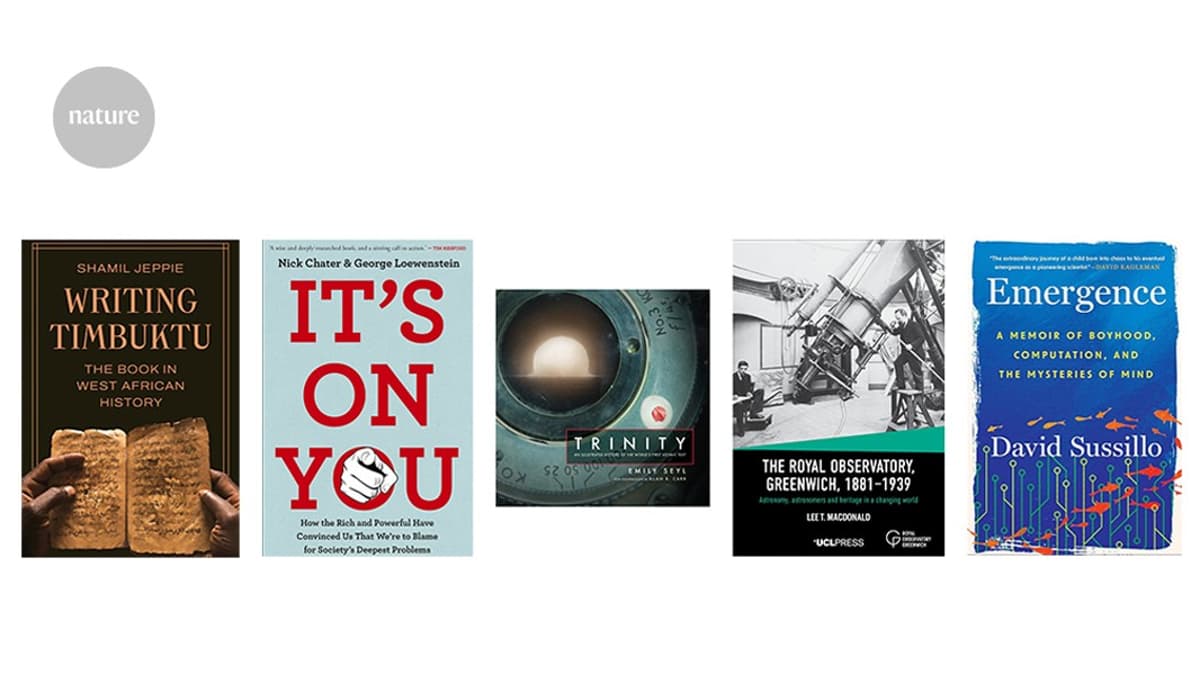
The release of Emily Seyl’s *Trinity* arrives at a moment when declassified archives are reshaping public perception of the atomic age. By pairing high‑resolution, restored photographs with narrative context, Seyl not only documents the technical marvel of the July 1945 test but also humanizes the scientists and technicians whose work birthed the nuclear era. This visual approach resonates with educators and museum curators seeking fresh material to illustrate the ethical and geopolitical fallout of nuclear weapons.
In *It’s On You*, behavioral economist George Loewenstein and psychologist Nick Chater confront a longstanding debate: can nudges alone solve grand challenges like climate change? Their latest argument favors robust legislative frameworks over subtle behavioral tweaks, citing the limited impact of voluntary carbon‑footprint reductions. The book’s timing aligns with a wave of climate‑related bills in U.S. Congress, offering policymakers a scholarly endorsement for market‑based regulations and corporate accountability measures.
David Sussillo’s *Emergence* provides a rare memoir that intertwines personal adversity with cutting‑edge neuroscience. Growing up amid addiction and violence, Sussillo turned to computing, eventually probing the brain’s circuitry and artificial intelligence. His reflections raise profound philosophical questions about agency and the direction of AI research, topics that are increasingly relevant as tech firms accelerate brain‑inspired models. Meanwhile, Shamil Jeppie’s *Writing Timbuktu* shines a light on the fragile legacy of West African manuscript collections, underscoring the urgency of digital preservation initiatives supported by UNESCO and private foundations. Together, these titles enrich discourse across science, policy, and cultural heritage, offering readers actionable insights and fresh perspectives.
Radioactive rain and proving relativity: Books in brief
Comments
Want to join the conversation?
Loading comments...