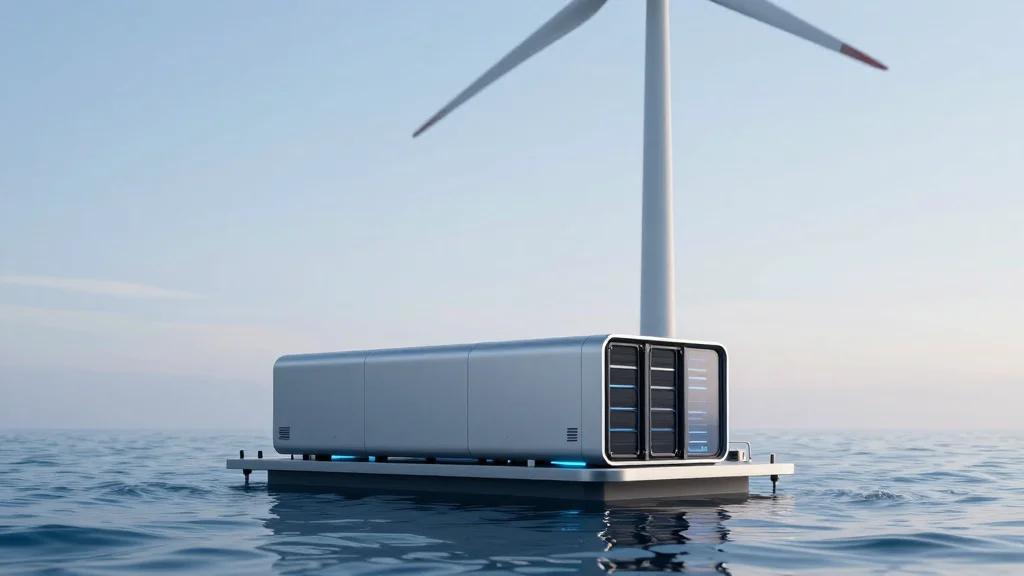
Aikido Unveils Offshore AI Platform to Cut Grid Strain with Wind, Batteries and Seawater Cooling

Why It Matters
Aikido’s offshore AI platform tackles two converging crises: soaring data‑center electricity demand and strained onshore grids. By co‑locating renewable generation, storage and cooling in a single marine footprint, the solution could dramatically cut the carbon intensity of AI workloads, a sector projected to double its power draw by 2030. If the claimed PUE below 1.08 is realized, operators could achieve up to a 30 % reduction in total energy consumption compared with the current industry average, translating into lower operating costs and a smaller environmental footprint. Beyond efficiency, the concept introduces a new class of critical infrastructure that operates at sea, prompting regulators to develop safety, security and permitting standards for hybrid energy‑computing installations. Successful deployment could spur a wave of offshore data‑center farms, diversifying supply chains and reducing dependence on land‑based power grids, which are increasingly vulnerable to climate‑induced disruptions.
Key Takeaways
- •Aikido Technologies unveiled AO60DC, a floating platform combining a 15‑18 MW wind turbine, battery storage and 10‑12 MW of AI compute.
- •Targeted PUE is below 1.08, compared with the 2024 industry average of 1.56.
- •Proof‑of‑concept unit slated for Norway deployment in late 2026; commercial UK project planned for 2028.
- •Data centers consumed 415 TWh in 2024 and are projected to reach 945 TWh by 2030, with AI as the primary driver.
- •Platform scalability ranges from tens of megawatts to over a gigawatt, enabling rapid capacity expansion without onshore grid upgrades.
Pulse Analysis
Aikido’s AO60DC arrives at a moment when the data‑center industry is grappling with both capacity and sustainability pressures. Historically, the sector has relied on onshore renewable farms and incremental efficiency gains, but the exponential rise of AI workloads is outpacing those measures. By moving the power‑and‑cooling loop to the ocean, Aikido sidesteps the most painful onshore constraints—land acquisition, transmission bottlenecks, and local opposition—while leveraging the high capacity factor of offshore wind, which often exceeds 50 % in the North Atlantic. This could set a new cost baseline for AI compute, especially for firms that can internalize the capital expense of offshore construction.
However, the model is not without risk. Offshore installations must survive corrosive saltwater, extreme weather, and potential geopolitical tensions over maritime zones. The capital intensity of building semisubmersible platforms and integrating high‑density servers could be higher than traditional data‑center builds, at least initially. Success will hinge on Aikido’s ability to demonstrate reliability and a clear total‑cost‑of‑ownership advantage. If the Norway prototype delivers the promised PUE and uptime, it could unlock financing from green‑bond markets and attract hyperscalers seeking to meet ESG commitments.
Looking ahead, the AO60DC concept could catalyze a broader shift toward “energy‑compute co‑location” in the climate‑tech arena. As policy frameworks evolve to reward low‑carbon compute, offshore farms may become a preferred asset class, prompting traditional data‑center operators to partner with renewable developers or acquire marine engineering expertise. The 2028 UK pilot will be a litmus test: its performance will either validate offshore AI as a scalable solution or relegate it to a niche experiment. Either outcome will reshape investment strategies across the climate‑tech and AI infrastructure ecosystems.
Aikido Unveils Offshore AI Platform to Cut Grid Strain with Wind, Batteries and Seawater Cooling
Comments
Want to join the conversation?
Loading comments...