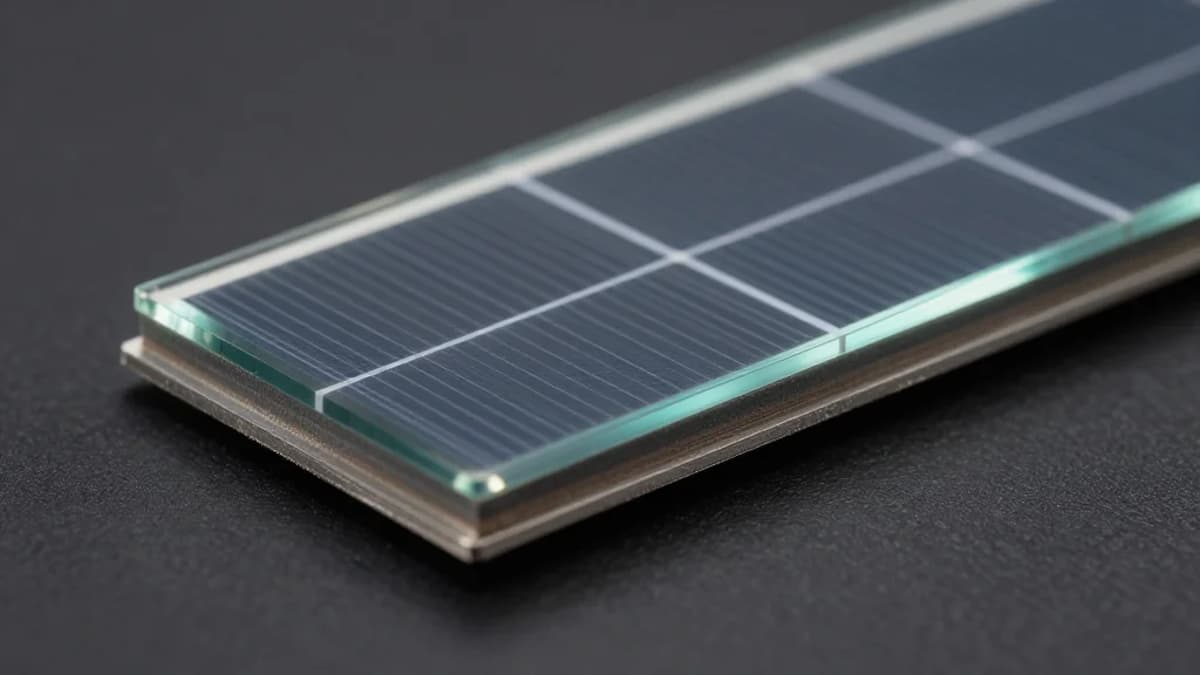
Dual‐Functional ITO Interlayer for Effective Defect Passivation and Cationic Composition Engineering in Kesterite Solar Cells
•March 11, 2026
0
Why It Matters
The approach demonstrates a practical route to boost kesterite cell performance without complex processing, advancing the competitiveness of earth‑abundant photovoltaics.
Key Takeaways
- •ITO serves as early-stage diffusion barrier
- •Later, ITO supplies Sn and In to absorber
- •Defect density drops, saturation current reduced tenfold
- •Cell efficiency reaches 13.11% with ITO interlayer
- •Strategy combines bulk doping and defect passivation
Pulse Analysis
Kesterite absorbers such as Cu2ZnSn(S,Se)4 have attracted attention because they rely on abundant, non‑toxic elements, yet their commercial adoption has been hampered by low efficiencies. Two persistent obstacles are the uncontrolled interdiffusion of metals at the molybdenum back contact and the formation of Sn‑related vacancies that act as non‑radiative recombination centers. Conventional strategies—like high‑temperature anneals or complex buffer layers—often add cost or introduce new defects. Consequently, researchers have been searching for a simple, scalable interface engineering solution that can simultaneously curb diffusion and heal bulk defects.
The recent study leverages a thin indium tin oxide (ITO) film as a dual‑functional interlayer. In the initial selenization stage, the ITO layer forms a robust barrier, preventing copper, zinc and tin atoms from migrating into the Mo electrode and thereby preserving the intended stoichiometry. As the temperature rises, the ITO gradually decomposes, releasing indium and tin atoms that diffuse back into the absorber. This self‑sacrificial behavior supplies the missing Sn and introduces trace In, which suppresses Sn vacancies and substitutional defects. The net effect is a ten‑fold reduction in reverse saturation current and a record 13.11 % conversion efficiency for the ITO‑10 sample.
From a commercial perspective, the ITO interlayer offers a low‑cost, CMOS‑compatible step that can be integrated into existing roll‑to‑roll sputtering lines. By improving carrier lifetime and reducing recombination, the technique narrows the performance gap between kesterite and incumbent thin‑film technologies such as CIGS. Moreover, the concept of a self‑sacrificing oxide could be extended to other emerging absorbers that suffer from similar interfacial loss. Future work will likely focus on optimizing layer thickness, scaling the process, and combining ITO with surface passivation schemes to push efficiencies beyond 15 %.
Dual‐Functional ITO Interlayer for Effective Defect Passivation and Cationic Composition Engineering in Kesterite Solar Cells
0
Comments
Want to join the conversation?
Loading comments...