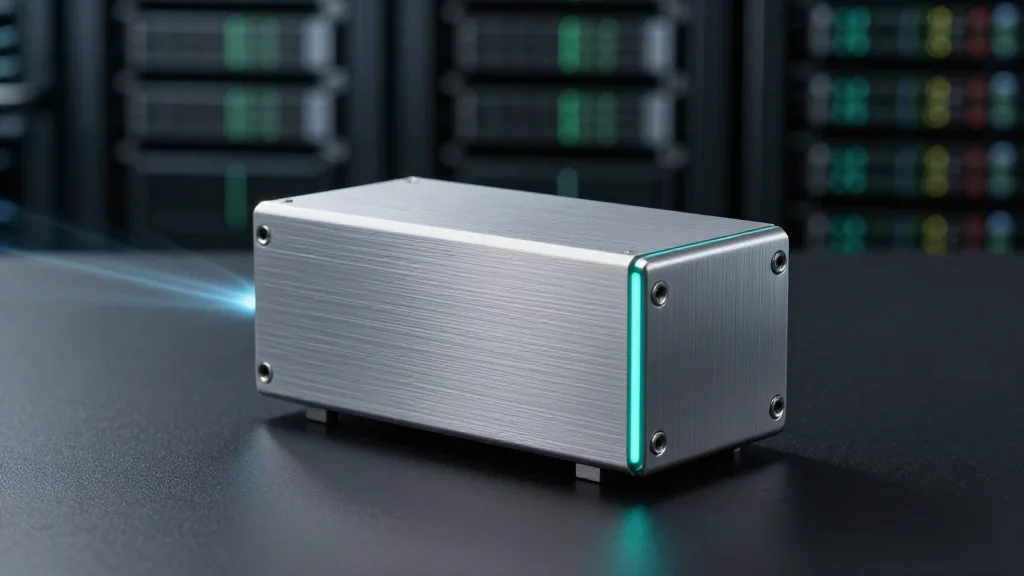
Enphase Energy Unveils 1.25 MW Solid‑State Transformer for AI Data‑Center Racks

Companies Mentioned
Why It Matters
The IQ SST could reshape the power architecture of AI data centers, a sector where power density and efficiency directly impact compute capacity and operating costs. By potentially removing UPS batteries and reducing conversion losses, operators may achieve higher rack utilization and lower total‑cost‑of‑ownership, accelerating the deployment of ever‑larger AI models. If Enphase’s solid‑state design proves reliable at megawatt scale, it may trigger a broader industry shift toward DC‑centric, software‑defined power distribution, challenging legacy transformer and UPS vendors and spurring new standards for high‑voltage DC in data‑center environments.
Key Takeaways
- •Enphase’s IQ SST delivers 1.25 MW per rack using 342 semiconductor modules.
- •Efficiency rated at 98.5% with 99.999% availability and built‑in redundancy.
- •Design eliminates internal batteries, potentially removing UPS sidecars.
- •Demonstrations slated for late 2024, pilots in 2027, volume shipments in 2028.
- •Uses GaN switching and a 22 nm “Kestrel” ASIC derived from Enphase’s microinverter line.
Pulse Analysis
Enphase’s entry into the AI data‑center power market is a strategic diversification that leverages its massive microinverter production capacity. The company’s ability to mass‑produce semiconductor‑based power modules at scale gives it a cost advantage over traditional transformer makers, who must retool for solid‑state designs. Historically, power conversion has been a bottleneck for AI workloads, with many operators resorting to over‑provisioned UPS systems to guarantee uptime. By offering a single‑stage, high‑efficiency solution, Enphase could lower the barrier to adopting 800 VDC architectures, a trend already gaining traction among hyperscale operators seeking to push compute density beyond the limits of 400 VDC.
The timeline is realistic but ambitious. Demonstrations this year will be critical for proving reliability under the sub‑millisecond load swings typical of large language model training. If the pilots in 2027 demonstrate the promised 90% module redundancy and fault‑ride‑through capabilities, Enphase could capture a niche of early adopters willing to trade legacy infrastructure for higher density. However, the market’s inertia and the stringent certification processes for data‑center power equipment mean that widespread adoption may lag the 2028 volume‑shipment target.
From a competitive standpoint, the SST pits Enphase against established players like ABB, Siemens, and Schneider Electric, all of whom are investing in solid‑state transformer research. Enphase’s advantage lies in its vertically integrated semiconductor supply chain and its proven GaN switching expertise from the residential solar market. If it can translate that reliability to the megawatt scale, the company could force incumbents to accelerate their own solid‑state roadmaps, potentially reshaping the power‑distribution ecosystem for AI data centers over the next decade.
Enphase Energy Unveils 1.25 MW Solid‑State Transformer for AI Data‑Center Racks
Comments
Want to join the conversation?
Loading comments...