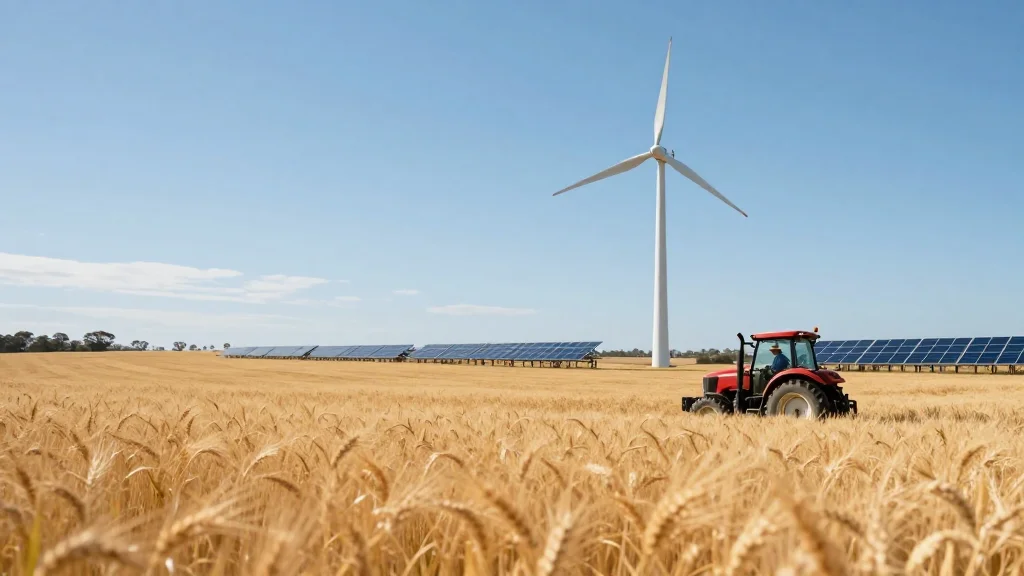
From Wool, to Cropping, to Solar: How Renewable Energy Can “Grow the Agricultural Pie”
Why It Matters
Treating agriculture as a high‑value business aligns renewable rollout with community economics, smoothing acceptance and preserving export‑ready crops while accelerating Australia’s clean‑energy goals.
Key Takeaways
- •Western Victoria hosts 68 renewable projects, 1.5 GW operating, 16 GW proposed.
- •Councils are establishing engagement rules and PILOR schemes for infrastructure costs.
- •Farmers in the region run $20‑$33 million‑USD agribusinesses, not just landholders.
- •Mismanaged construction has caused crop contamination, hurting export markets.
- •Regional Energy Collaboration seeks to grow the agricultural pie through joint planning.
Pulse Analysis
Western Australia’s renewable surge is now spilling into the grain‑rich plains of Victoria, where 68 wind, solar and battery projects are either operating or in the pipeline. With 1.5 GW already online and up to 16 GW of proposed capacity, the region is poised to become a cornerstone of the nation’s clean‑energy grid. Yet the sheer scale of infrastructure—new 500 kV transmission lines, substations, and construction crews—has sparked community pushback, underscoring the need for a partnership model that respects local economic realities.
Farmers in the Wimmera and Southern Mallee are not hobbyists; they run enterprises valued at roughly $20‑$33 million USD in assets, exporting wheat, barley and pulses to markets like Japan. When developers treat them as simple landholders, project spill‑over—such as debris contaminating hay or stone‑laden fields—directly harms export quality and revenue. These incidents illustrate a broader risk: misaligned construction schedules and logistics can disrupt planting cycles, inflate biosecurity costs, and erode the profitability of an industry already coping with weather volatility and global trade pressures.
In response, councils across the renewable zones are formalising engagement protocols, from early‑stage briefings to payment‑in‑lieu‑of‑rates (PILOR) schemes that fund road upgrades and community services. The Regional Energy Collaboration brings developers, local governments, and farm operators together to map out shared infrastructure, mitigate biosecurity threats, and ensure that new energy assets complement, rather than compromise, agricultural productivity. By treating farms as high‑value businesses, the sector can foster win‑win outcomes, accelerate project timelines, and reinforce Australia’s ambition to meet its net‑zero targets without sacrificing the agricultural pie.
From wool, to cropping, to solar: How renewable energy can “grow the agricultural pie”
Comments
Want to join the conversation?
Loading comments...