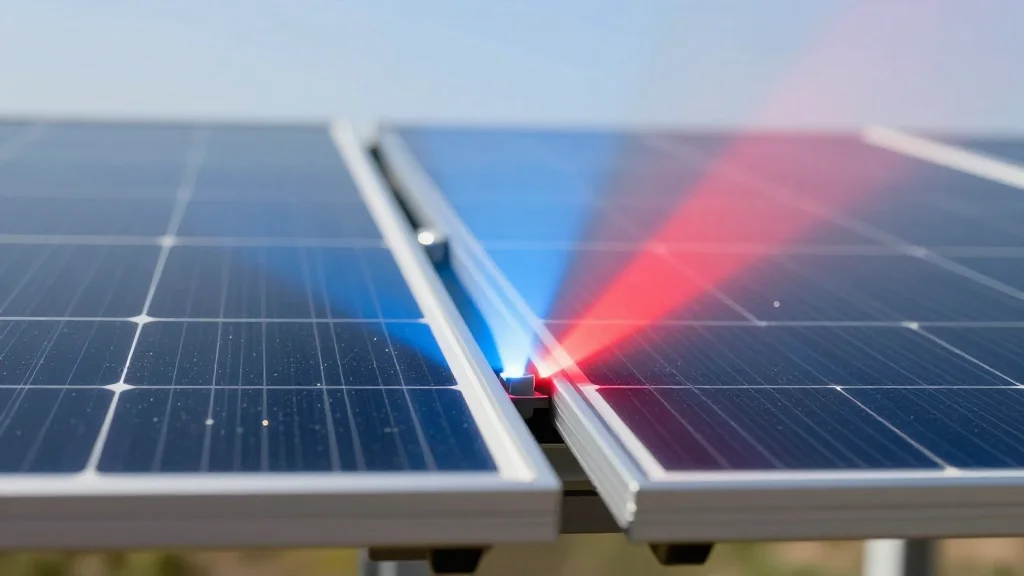
Japanese Scientists Build All-Perovskite Tandem Solar Cell with 30.2% Efficiency
Why It Matters
The breakthrough proves that all‑perovskite tandems can surpass 30% efficiency, opening a pathway to cheaper, high‑performance photovoltaics, yet commercial adoption hinges on reducing optical‑component costs.
Key Takeaways
- •30.2% efficiency sets new benchmark for all‑perovskite tandems
- •Spectral splitting at 775 nm maximizes light utilization across subcells
- •Four‑terminal design eliminates current‑matching constraints, improving flexibility
- •FAPbI3 nanoparticles enable stable α‑phase perovskite films
- •Dichroic mirror cost remains primary barrier to commercial deployment
Pulse Analysis
Perovskite photovoltaics have surged from laboratory curiosities to serious contenders against crystalline silicon, driven by rapid efficiency gains and low‑temperature processing. Recent milestones have pushed single‑junction perovskites past the 25% barrier, but the Shockley‑Queisser limit still caps their potential. Tandem architectures—stacking two cells with complementary bandgaps—offer a logical route to higher conversion, and the University of Tokyo’s four‑terminal design showcases how spectral splitting can extract near‑optimal performance without the current‑matching constraints that plague traditional two‑terminal tandems.
The Tokyo team’s approach hinges on formamidinium lead iodide (FAPbI3) nanoparticles, which are deposited via a two‑step spin‑coating and annealing sequence that stabilizes the coveted α‑phase. By pairing a 24.4% wide‑bandgap top cell with a 21.5% narrow‑bandgap bottom cell and separating incoming sunlight with a dichroic mirror at 775 nm, each subcell receives photons it can convert most efficiently. This optical architecture minimizes thermalization and transmission losses, delivering a combined 30.2% efficiency—one of the highest reported for all‑perovskite tandems. The four‑terminal configuration also provides redundancy: a failure in one subcell does not cripple the entire module, simplifying maintenance and potentially extending system lifespan.
Despite the technical triumph, commercial rollout faces practical hurdles. Dichroic mirrors, essential for the spectral‑splitting scheme, remain expensive and add complexity to module assembly. Industry analysts therefore anticipate a near‑term focus on monolithic two‑terminal tandems or mechanically stacked four‑terminal designs that can leverage existing manufacturing lines. If cost‑effective optical components or alternative splitting strategies emerge, the high‑efficiency perovskite tandem could challenge silicon’s dominance in utility‑scale and rooftop markets, delivering higher energy yields with reduced material footprints. Continued advances in material stability, encapsulation, and scalable deposition will be critical to translating laboratory records into market‑ready products.
Japanese scientists build all-perovskite tandem solar cell with 30.2% efficiency
Comments
Want to join the conversation?
Loading comments...