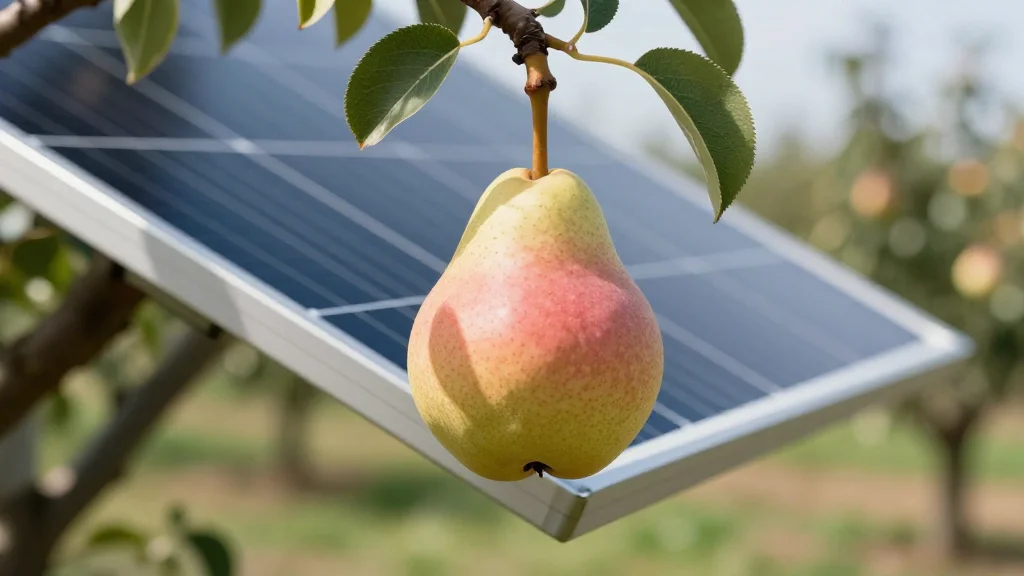
Long-Term Trade-Offs of Agrivoltaics on Pear Farming
Why It Matters
The results highlight that while agrivoltaics can diversify farm revenue and protect crops from extreme weather, the loss in yield and quality could offset financial gains, forcing growers to weigh energy benefits against agricultural productivity.
Key Takeaways
- •Panels reduced sunburn and hail damage.
- •Yield dropped 40% under shading.
- •5°W orientation generated 10% more energy.
- •Fruit blush coloration decreased with shade.
- •Long‑term economics remain uncertain for growers.
Pulse Analysis
Agrivoltaics—combining photovoltaic arrays with agriculture—has surged as a climate‑resilient strategy, yet the Australian pear study underscores the nuanced balance between energy capture and crop performance. By installing stainless‑steel structures with panels tilted either 5° or 45° west, researchers recorded a 10% energy advantage for the shallower angle, which aligned sunlight more evenly throughout the day. This configuration also lowered leaf temperatures and improved photosystem efficiency, offering tangible benefits for orchard microclimates, especially during heatwaves and hail events.
Conversely, the shade cast by the panels markedly suppressed fruit development. Over four seasons, shaded trees produced 77‑89 t ha⁻¹ versus 137 t ha⁻¹ in the unshaded control, and the characteristic red blush faded, reducing market appeal. The reduction in soluble solids further signals quality degradation, a critical concern for premium pear markets. While trunk growth accelerated early in the season due to better water availability, the overall yield penalty raises questions about the net profitability of dual‑use systems for high‑value fruit growers.
The broader implication for the agrifood sector is clear: successful agrivoltaic deployment will require site‑specific design, possibly integrating tracker‑based or semi‑transparent modules to modulate shade intensity. Economic models must factor in energy sales, reduced crop loss, and potential premium pricing for sustainably produced fruit. As policymakers and investors push for renewable integration, the Australian findings serve as a cautionary benchmark, urging further research to optimize the trade‑offs before scaling agrivoltaics across orchards worldwide.
Long-term trade-offs of agrivoltaics on pear farming
Comments
Want to join the conversation?
Loading comments...