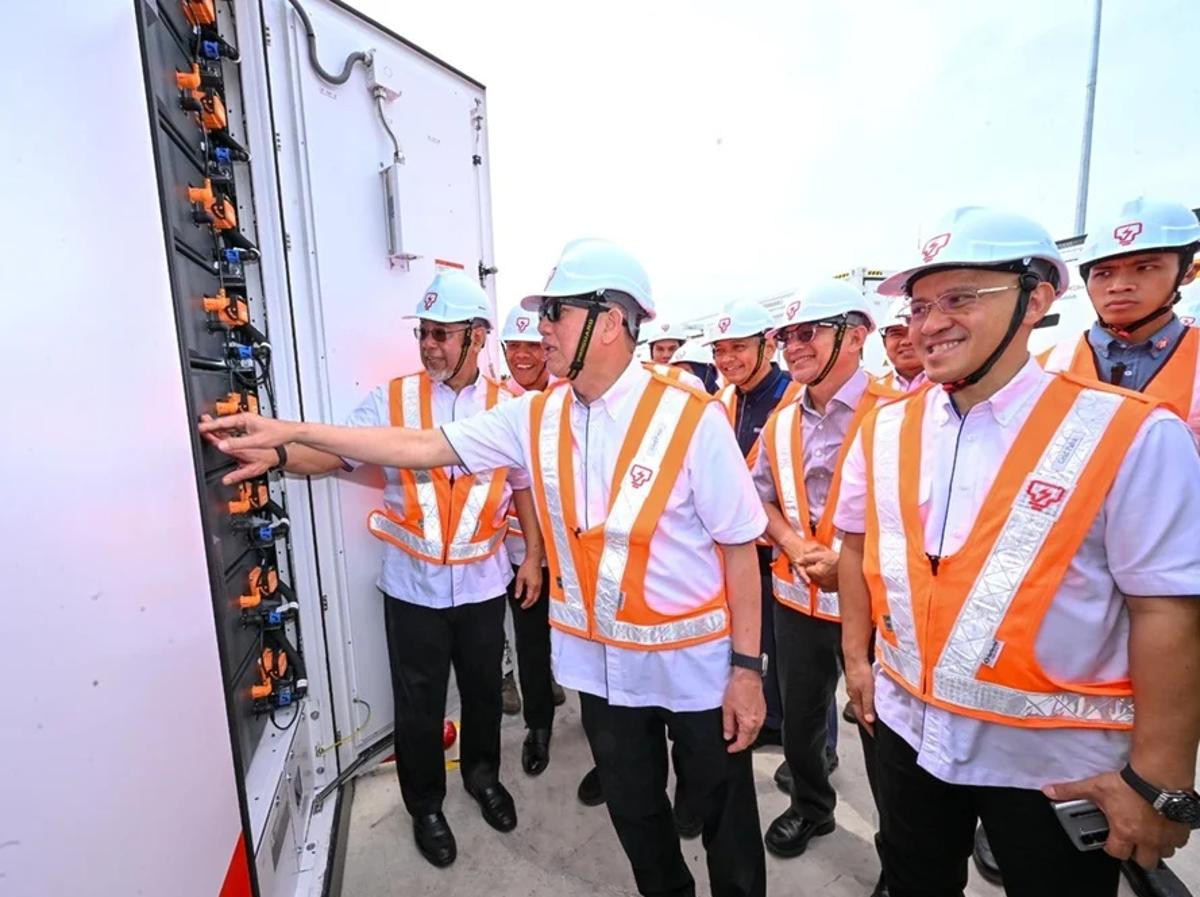
Malaysian Utility TNB Connects 100MW/400MWh Grid-Forming Battery Storage Project to Grid
Companies Mentioned
Why It Matters
The Santong BESS demonstrates how large‑scale storage can underpin Malaysia’s renewable‑energy ambitions, reducing reliance on fossil‑fuel peakers and enhancing grid reliability. Its success paves the way for the MyBeST programme and positions the region as a hotspot for grid‑scale battery investments.
Key Takeaways
- •Santong BESS adds 100 MW/400 MWh capacity to Malaysia’s grid
- •Grid‑forming inverters enable real‑time supply‑demand balancing
- •Project supports renewable integration for 40,000 East Coast households
- •Malaysia targets 500 MW of BESS by 2030 under NETR
- •TNB’s overseas portfolio includes 1.3 GW renewable assets
Pulse Analysis
The commissioning of Tenaga Nasional Berhad’s Santong battery energy storage system marks a watershed moment for Malaysia’s power sector. At 100 MW of power and 400 MWh of energy, the project is the first grid‑forming battery to feed the mainland’s 132/33 kV network, reinforcing the National Energy Transition Roadmap’s ambition to reach 70 % renewable electricity by 2050. With more than 11 million customers and a 3.3 GW generation fleet, TNB is leveraging the BESS to smooth the intermittency of new solar farms while protecting the reliability of its transmission and distribution operations.
The Santong installation uses liquid‑cooled, grid‑forming (GFM) inverters that can operate independently of a conventional generator, instantly matching supply to demand fluctuations. This capability allows the system to provide fast frequency response, peak‑shaving, and black‑start services, effectively reducing the need for fossil‑fuel peaker plants. By stabilising voltage and frequency, the BESS makes it feasible to connect larger solar arrays on the East Coast, where daylight hours are abundant but grid constraints have limited expansion. TNB estimates the storage can reliably serve roughly 40 000 households during peak periods.
Malaysia’s BESS rollout is still in its infancy, but the Santong project sets a benchmark for the four‑unit MyBeST programme slated for 2027, which will add another 400 MW/1 600 MWh of storage capacity. The earlier 100 MW/400 MWh system in Sabah demonstrated the country’s appetite for large‑scale batteries, positioning Southeast Asia as a growing market for grid‑scale storage technology. TNB’s experience, combined with its 1.3 GW renewable portfolio abroad, gives it a competitive edge as investors seek projects that align with global decarbonisation targets and regional grid‑modernisation plans.
Malaysian utility TNB connects 100MW/400MWh grid-forming battery storage project to grid
Comments
Want to join the conversation?
Loading comments...