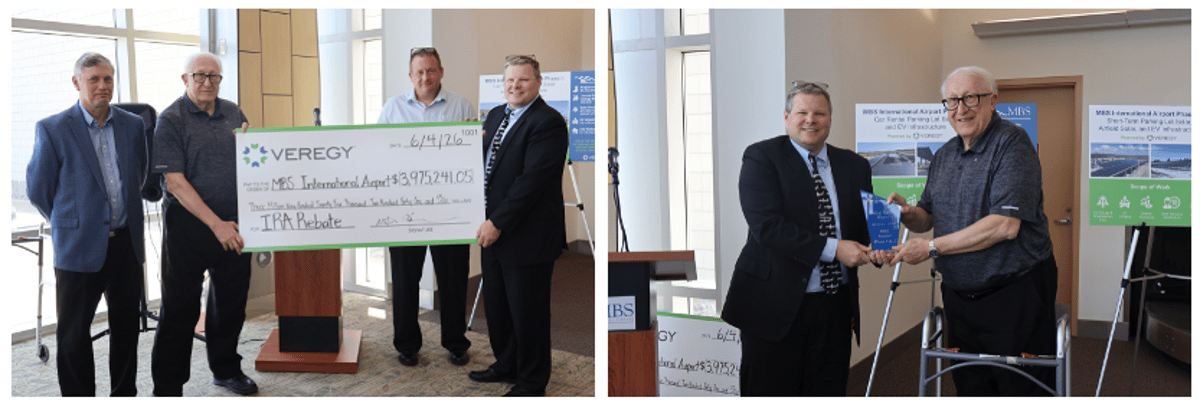
MBS International Airport Hosts Ribbon-Cutting to Celebrate Award-Winning Solar and EV Infrastructure Project
Why It Matters
The initiative positions MBS as a sustainability leader among regional airports, demonstrating how federal incentives can accelerate clean‑energy upgrades while delivering measurable cost reductions.
Key Takeaways
- •MBS solar array is Michigan’s largest airport solar installation
- •Project secured $3.9 million federal rebate, exceeding original $2.8 million estimate
- •Phase II adds 646 kW canopy and 216 kW ground‑mounted panels
- •Annual energy savings projected at $351,849, delivering ROI in ~10 years
- •EV chargers include Level 1, Level 2, DC Fast, and electric aircraft
Pulse Analysis
Airports are increasingly viewed as energy‑intensive hubs, yet they also have expansive roof and parking‑lot real estate ideal for solar generation. MBS International Airport leveraged that footprint to install a 342‑kW car‑port canopy in Phase I and expanded to a 646‑kW canopy plus 216‑kW ground‑mounted array in Phase II, creating Michigan’s largest airport solar installation. By coupling the solar canopies with Level 1, Level 2, DC‑Fast, and even electric‑aircraft chargers, the airport not only reduces its carbon footprint but also enhances the passenger experience with illuminated, covered parking. The project’s public‑private partnership model, anchored by Veregy’s engineering expertise, showcases how regional airports can execute large‑scale decarbonization without relying on new tax revenue.
Financially, the program is a textbook case of leveraging federal policy for local benefit. The Inflation Reduction Act awarded MBS a $3.9 million rebate—significantly higher than the $2.8 million initially projected—bringing total project funding to $9.5 million, all sourced from airport revenues and operational savings. Phase I already generates $26,849 in guaranteed annual energy savings, while Phase II is expected to deliver over $325,000 in yearly savings and more than 1 million kWh of clean electricity. At the current savings rate, the airport anticipates a positive return on investment within ten years, a timeline that aligns with typical infrastructure lifecycles and underscores the fiscal prudence of renewable upgrades.
MBS’s success arrives as the aviation sector confronts mounting pressure to cut emissions and meet ESG expectations. The airport’s integrated approach—solar generation, EV infrastructure, and real‑time production monitoring—provides a replicable blueprint for midsize airports seeking to modernize without compromising budgets. Companies like Veregy, with a portfolio exceeding $2.1 billion in energy‑saving projects, are becoming critical enablers, offering turnkey solutions that streamline permitting, financing, and construction. As more airports adopt similar models, the cumulative impact could shave millions of tons of CO₂ from the national aviation footprint while delivering long‑term operational resilience.
MBS International Airport Hosts Ribbon-Cutting to Celebrate Award-Winning Solar and EV Infrastructure Project
Comments
Want to join the conversation?
Loading comments...