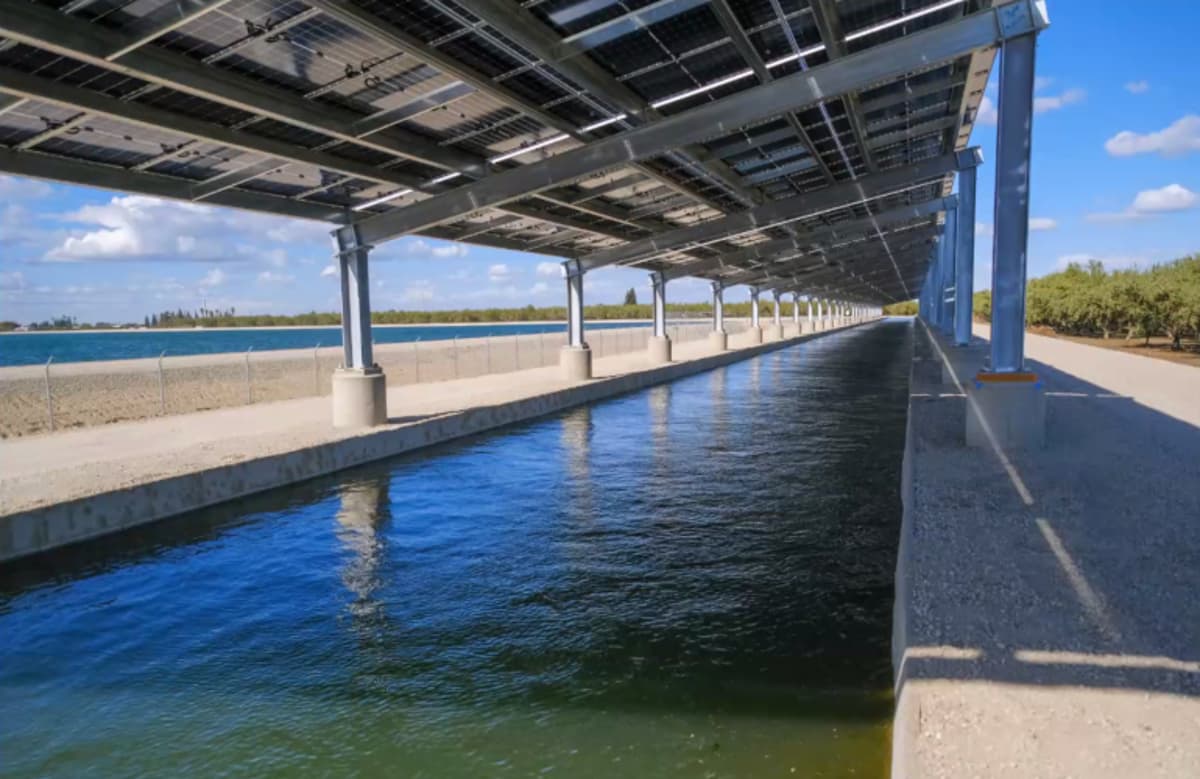
Project Nexus Solar Canal Demo Completes Construction in California
Why It Matters
By turning existing water corridors into power‑generating assets, Project Nexus offers a scalable path to boost clean energy capacity while conserving scarce water resources, a critical need for California and other water‑intensive regions.
Key Takeaways
- •Solar arrays installed over 115‑ft and 25‑ft canal spans.
- •Early data show reduced evaporation and aquatic‑weed growth.
- •Project integrates iron‑flow battery storage for grid flexibility.
- •Vertical and retractable “Solar Waves” designs test deployment versatility.
- •California’s 4,000 miles of canals present massive renewable potential.
Pulse Analysis
The concept of mounting photovoltaic panels on irrigation canals has moved from theory to field‑tested reality in California’s Central Valley. By leveraging existing water‑way corridors, utilities can generate clean electricity without consuming additional land—a critical advantage in a state where agricultural acreage and water rights are fiercely contested. The approach also creates a shade canopy that curtails surface evaporation, a benefit that directly addresses the chronic water‑stress amplified by climate change. As California pushes toward its 100 % clean‑energy goal by 2045, such hybrid infrastructure offers a pragmatic shortcut to both energy and water resilience.
Project Nexus, a collaboration among the state Department of Water Resources, Turlock Irrigation District, Solar AquaGrid, and UC Merced, embodies this dual‑purpose vision. The pilot comprises a 38,500‑square‑foot wide‑span array, two 40,500‑square‑foot narrow‑span sections, a vertical‑mount system, and a retractable “Solar Waves” rail, each paired with long‑duration iron‑flow batteries. Preliminary measurements from the first irrigation season indicate a measurable drop in evaporative loss and a suppression of aquatic‑weed proliferation, echoing findings from UC Merced’s 2021 Nature Sustainability paper. These early metrics validate the technical feasibility of canal‑top solar while delivering grid‑scale storage flexibility.
With roughly 4,000 miles of open canals, California alone could host gigawatts of solar capacity, translating into billions of kilowatt‑hours of clean power and substantial water savings. Policymakers are watching the Nexus data to shape incentives for utility‑scale deployments, while other water‑rich states—from Arizona to Texas—are evaluating similar projects. If the final report confirms the pilot’s performance, the model could accelerate nationwide adoption, turning a traditionally passive water conveyance system into an active component of the renewable energy grid.
Project Nexus solar canal demo completes construction in California
Comments
Want to join the conversation?
Loading comments...