Pseudo-Planar Heterojunction Organic Solar Cell Achieves World Record Efficiency of 20.21%
Why It Matters
The breakthrough provides a manufacturable method to boost both efficiency and stability of organic solar cells, accelerating their path toward commercial deployment and competitive positioning against silicon and perovskite technologies.
Key Takeaways
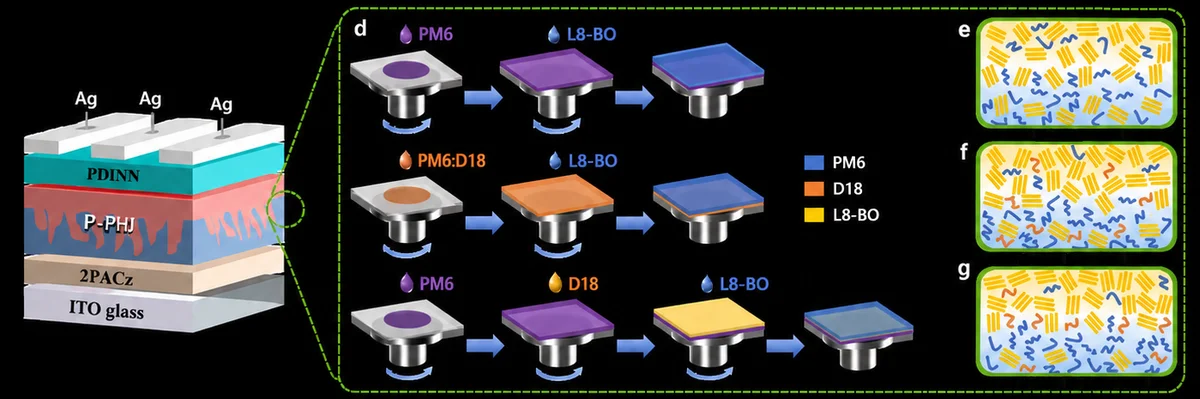
- •Buffer layer D18 prevents solvent erosion in layer‑by‑layer OSC fabrication
- •PM6/D18/L8‑BO architecture reaches 19.80% efficiency, beating reference cells
- •Adding BTP‑eC9 pushes efficiency to 20.21%, a PPHJ record
- •Improved morphology reduces trap states and non‑radiative losses
- •Strategy offers scalable, erosion‑immune production for high‑performance organic photovoltaics
Pulse Analysis
Organic photovoltaics have long promised low‑cost, flexible energy generation, but their commercial viability hinges on achieving both high power‑conversion efficiency and reliable manufacturing. Pseudo‑planar heterojunction (PPHJ) cells blend the well‑defined donor‑acceptor interfaces of planar designs with the superior charge‑separation pathways of bulk heterojunctions, making them a leading architecture for record‑setting efficiencies. However, the layer‑by‑layer (LBL) deposition process traditionally suffers from solvent‑induced intermixing, which degrades morphology, increases recombination, and hampers reproducibility. Overcoming this bottleneck is essential for scaling organic solar modules beyond laboratory prototypes.
The Chinese research team introduced a crystalline polymer, D18, as an interfacial buffer between the PM6 donor and the L8‑BO acceptor. This thin, solvent‑resistant layer shields the donor during subsequent spin‑coating, preserving vertical phase separation and suppressing trap formation. Devices employing the PM6/D18/L8‑BO stack delivered 19.80 % efficiency, outpacing the 18.53 % baseline and the 19.21 % blend‑only variant. By pre‑blending a non‑fullerene acceptor (BTP‑eC9) with L8‑BO, the team nudged performance to 20.21 %, establishing a new benchmark for PPHJ organic solar cells.
The buffering approach offers a practical pathway to erosion‑immune LBL fabrication, a critical step toward roll‑to‑roll production and large‑area module uniformity. Reducing non‑radiative losses and accelerating hole transport not only lifts efficiency but also improves operational stability, addressing two of the main hurdles for market adoption. As organic photovoltaics compete with perovskite and silicon technologies, such scalable process innovations could accelerate investment and accelerate supply‑chain development. Future work will likely explore alternative polymer buffers, compatibility with diverse donor‑acceptor pairs, and integration into tandem architectures, further expanding the commercial outlook for high‑performance organic solar cells.
Pseudo-planar heterojunction organic solar cell achieves world record efficiency of 20.21%
Comments
Want to join the conversation?
Loading comments...