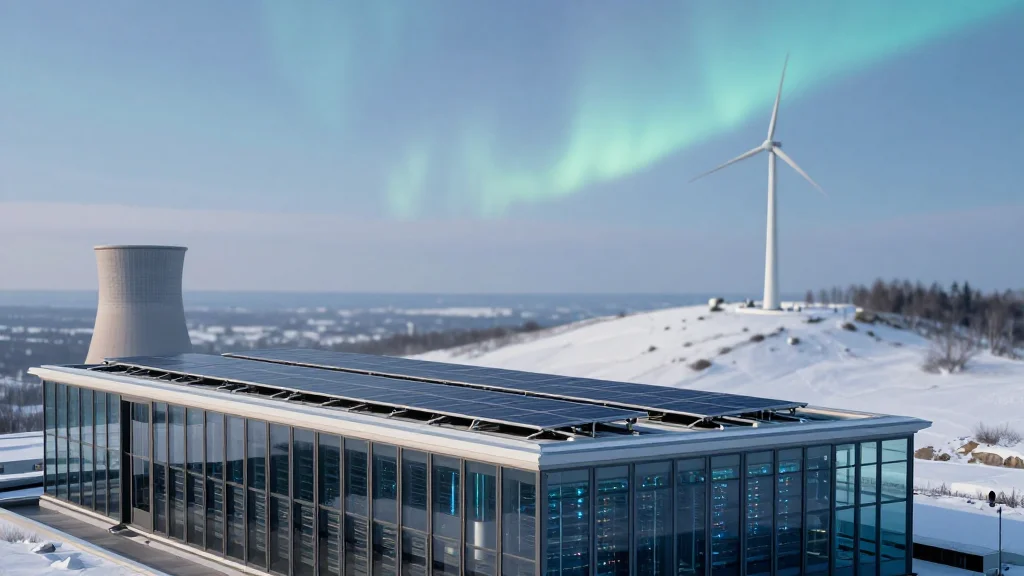
Renewables-Powered Data Centers Feasible with Sevenfold Solar and Wind Overbuild, Study Finds
Why It Matters
Demonstrating that renewables can economically supply baseload power to data centers could accelerate green‑cloud investments and reduce reliance on nuclear or fossil fuels, influencing policy and site selection worldwide.
Key Takeaways
- •Data centers need 7× renewable capacity for continuous power.
- •Backup plant and demand flexibility remain essential despite overbuild.
- •Favorable Nordic sites cut LCOE to $92/MWh, 24% lower.
- •Solar‑plus‑storage LCOE rivals nuclear in high‑latitude regions.
- •Study will expand to real‑world data center cases in 2026.
Pulse Analysis
The rapid growth of hyperscale data centers has made electricity consumption a strategic cost driver and a sustainability focal point. Traditionally, operators have relied on grid power, often sourced from fossil‑fuel plants or nuclear stations, to guarantee the 24/7 availability required for cloud services. A new study from LUT University in Finland challenges that paradigm by modeling an off‑grid system that combines wind, solar, battery energy storage and a backup generator to supply a continuous 1 GW load in a Nordic climate. The researchers aimed to answer whether intermittent renewables can truly replace conventional baseload sources without compromising reliability.
The analysis revealed a striking requirement: to achieve uninterrupted service, renewable capacity must be oversize by roughly sevenfold the average demand. Even with such overbuild, excess generation would be curtailed during peak sun or wind periods, and batteries alone cannot bridge all gaps. Consequently, a dispatchable backup plant remains indispensable, while demand‑side flexibility—such as shifting non‑critical workloads—can lower operating costs but may increase curtailment. Cost outcomes vary dramatically by site; the most favorable Nordic location delivers an LCOE near €80 ($92)/MWh, roughly 24 % cheaper than the least favorable location, putting renewable baseload on par with nuclear pricing.
These findings carry weight for cloud providers, data‑center investors and policymakers. Demonstrating that renewable‑based baseload can compete financially with nuclear opens a pathway for greener cloud infrastructure, especially in regions where grid connections are constrained or carbon‑intensity is high. The study’s next phase, the Net Zero Energy Communities project, will apply the model to real‑world facilities, providing granular insights into cooling loads, dynamic demand and regulatory hurdles. As the industry seeks to meet ESG targets and mitigate energy‑price volatility, the ability to locate data centers in renewable‑rich zones could become a decisive competitive advantage.
Renewables-powered data centers feasible with sevenfold solar and wind overbuild, study finds
Comments
Want to join the conversation?
Loading comments...