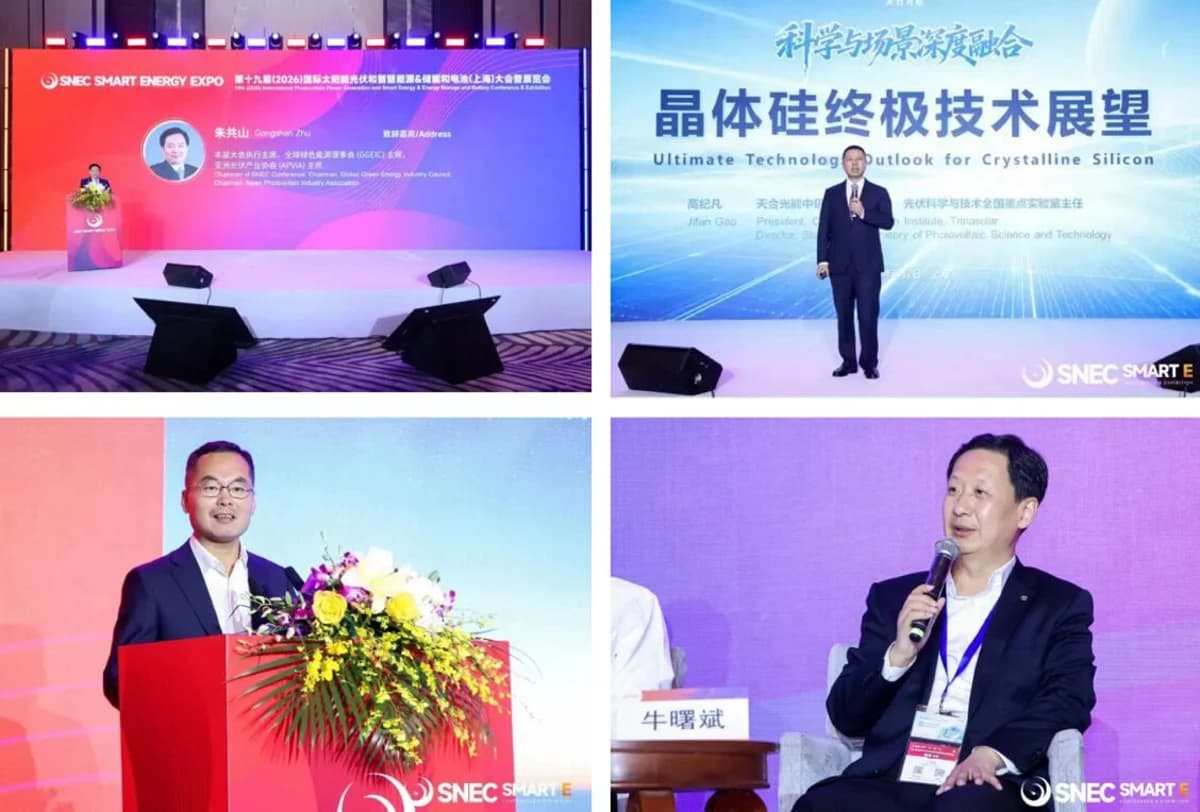
SNEC 2026: Industry Leaders Signal Shift From Destructive Price Wars to Value Competition
Companies Mentioned
Why It Matters
Shifting from price‑centric competition to integrated value creation will restore margins, spur innovation, and position Chinese PV firms as global energy‑service providers. This transition reshapes supply chains and accelerates adoption of AI‑driven renewable solutions worldwide.
Key Takeaways
- •SNEC 2026 marks shift from price wars to value‑driven competition
- •GCL closed 786 MWh green‑power deals, supporting 2 B kWh certificates in 2025
- •Trina Solar’s THBC cells achieve 28% efficiency, adding $0.02‑$0.03/W revenue
- •Envision’s Operations 3.0 focuses on AI‑enabled full‑lifecycle energy services
- •Industry roadmap emphasizes AI‑compute coordination and space‑based PV development
Pulse Analysis
China’s photovoltaic market has long been defined by aggressive capacity builds that created chronic oversupply and razor‑thin margins. The SNEC 2026 expo underscored a strategic pivot: firms are abandoning the zero‑sum game of price undercutting in favor of a value‑led approach that integrates generation, storage, and digital services. By aligning production with real‑world performance metrics and diversified revenue streams, the industry aims to stabilize earnings and reduce cyclical volatility that has plagued tier‑one manufacturers for years.
Technological innovation sits at the heart of this transformation. Trina Solar unveiled its THBC (TOPCon‑compatible hybrid back‑contact) cells, delivering a record 28% conversion efficiency and an incremental $0.02‑$0.03 per watt of revenue compared with conventional modules. The company also showcased 907‑watt ultra‑high‑output panels and a roadmap that blends TOPCon 3.0, perovskite‑silicon tandems, and a three‑technology portfolio to serve both utility‑scale farms and distributed rooftop projects. By championing full‑lifecycle output as the primary performance benchmark, Trina is pushing the sector toward more transparent, real‑world yield assessments.
Beyond hardware, the sector is embracing AI‑driven energy services and end‑to‑end asset management. Envision’s Operations 3.0 framework leverages large‑scale meteorology and energy models to optimize grid integration, while GCL’s green‑power trading platform has already secured 786 million kWh of contracts, backed by 2 billion kWh of tradable certificates. The two‑phase industry vision—linking compute power with green energy and exploring space‑based PV—signals a long‑term shift toward digital, service‑oriented business models. For investors and global partners, these developments suggest a more resilient, innovation‑rich PV landscape poised to capture emerging markets and drive sustainable growth.
SNEC 2026: Industry leaders signal shift from destructive price wars to value competition
Comments
Want to join the conversation?
Loading comments...