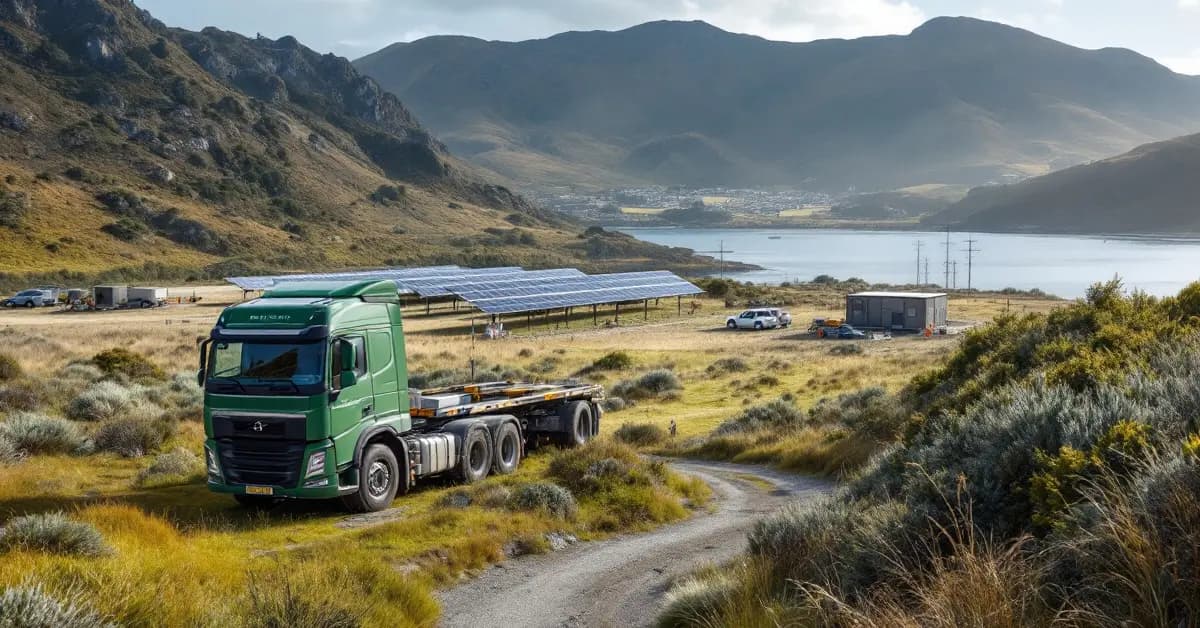
Solar And Battery Project Begins On Stewart Island To Cut Diesel Use And Power Costs
Why It Matters
Reducing diesel dependence lowers operating costs and emissions for a remote community, while enhancing energy security and supporting local economic activity.
Key Takeaways
- •NZ$15.35 million (≈ $9.2 million USD) loan funds solar‑battery project.
- •Diesel generation expected to drop by up to 75 percent.
- •Electricity rates could fall by as much as 35 cents/kWh.
- •Project creates ~40 full‑time‑equivalent construction jobs.
- •Completion slated for early 2027, boosting island’s energy resilience.
Pulse Analysis
Remote islands like Stewart Island face steep electricity costs because they depend on diesel generators that must be shipped and stored on‑site. New Zealand’s national grid does not reach the island, leaving residents paying more than double mainland rates. The government’s Regional Infrastructure Fund, part of a broader push to diversify energy sources after declining gas reserves, is stepping in with a sizable loan to replace fossil‑fuel reliance with renewable technology.
The solar‑battery initiative combines a modest‑size photovoltaic array with a lithium‑ion storage system, complemented by network upgrades and smart meters that enable real‑time demand management. By shaving up to three‑quarters of diesel consumption, the project not only cuts fuel imports but also promises to shave up to 35 cents per kilowatt‑hour off consumer bills. For the island’s 494 households and businesses, this translates into tangible savings that can boost tourism operators, aquaculture farms and other local enterprises that previously grappled with volatile energy costs.
Beyond immediate financial relief, the development creates roughly 40 full‑time‑equivalent construction jobs and sets a template for other isolated communities worldwide. It aligns with New Zealand’s climate commitments and showcases how targeted public financing can accelerate renewable adoption in hard‑to‑reach markets. As the system comes online in early 2027, Stewart Island will become a case study in how solar and storage can deliver energy resilience, lower emissions, and economic uplift for remote regions.
Solar And Battery Project Begins On Stewart Island To Cut Diesel Use And Power Costs
Comments
Want to join the conversation?
Loading comments...