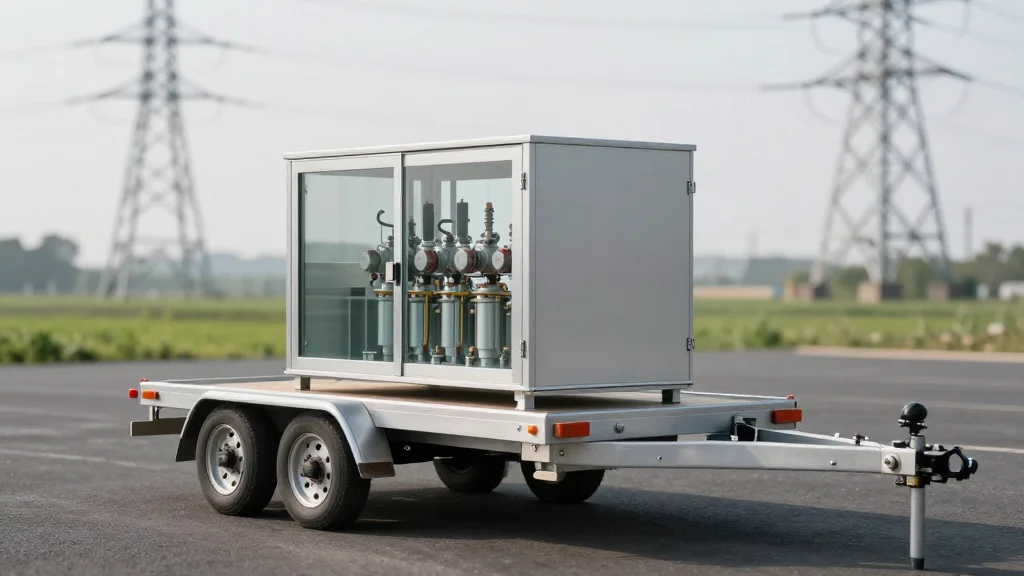
Toshiba Delivers Indigenous 132kV Mobile GIS System to Power Grid
Why It Matters
The delivery expands mobile high‑voltage solutions for India’s grid, boosting flexibility and resilience as utilities modernize. It showcases domestic manufacturing of advanced power equipment, reducing reliance on imports.
Key Takeaways
- •Toshiba’s 132 kV mobile GIS now operational at Power Grid
- •Indigenous design meets stringent Indian transmission standards
- •Mobile GIS enables rapid deployment for renewables and emergencies
- •Follow‑on 400 kV mobile GIS slated for later 2026
- •Supports India’s shift toward grid flexibility and local sourcing
Pulse Analysis
India’s power transmission landscape is undergoing a rapid transformation, driven by the need for faster, more flexible infrastructure. Toshiba’s 132 kV mobile gas‑insulated switchgear (m‑GIS) represents a significant step forward, offering a compact, trailer‑transportable solution that can be installed and relocated with minimal downtime. By developing the system entirely in India, Toshiba taps into local engineering talent and supply chains, lowering costs and shortening lead times compared with imported alternatives. This aligns with the government’s Make in India agenda and the broader industry push for domestically sourced high‑voltage equipment.
The arrival of mobile GIS technology addresses several pressing challenges for utilities. Grid operators increasingly require modular assets that can be dispatched quickly to support renewable integration, where generation sites are often remote or intermittently connected. Moreover, the ability to mobilize high‑voltage switchgear for emergency restoration reduces outage durations and enhances system resilience. Competitors such as ABB and Siemens are also exploring mobile solutions, but Toshiba’s early entry and proven 220 kV deployment give it a competitive edge in the Indian market, where rapid scaling is essential to meet growing demand.
Looking ahead, Toshiba’s roadmap includes a 400 kV indigenous mobile GIS slated for delivery later in 2026. If successful, this could open new opportunities for high‑capacity projects, including offshore wind farms and cross‑border interconnectors. The move also signals a broader trend of localized high‑tech manufacturing in the power sector, potentially lowering import dependence and fostering export potential to neighboring regions. For investors and industry stakeholders, the rollout underscores a shift toward agile, resilient grid assets that can keep pace with India’s ambitious clean‑energy targets.
Toshiba delivers indigenous 132kV mobile GIS system to Power Grid
Comments
Want to join the conversation?
Loading comments...