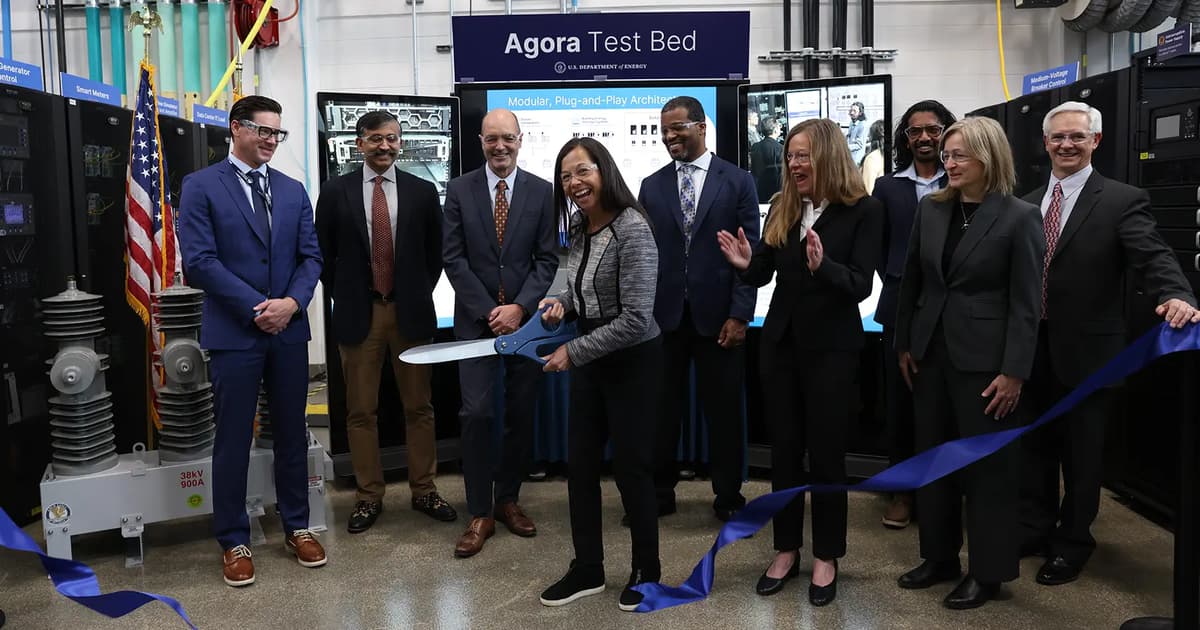
US DOE Launches Data Center Grid Integration Test-Bed at National Laboratory of the Rockies
Companies Mentioned
Why It Matters
Agora gives data centers a controlled environment to prove they can act as grid resources, accelerating the shift toward a more resilient, low‑carbon power system. The initiative also creates a collaborative pipeline for standards and best practices that could reshape utility‑data‑center relationships.
Key Takeaways
- •Agora is the only large‑load grid test bed in U.S. labs
- •DOE partners with Schneider Electric, Compass Datacenters, Verrus
- •Data centers can now trial real‑time demand‑response strategies
- •Emerald AI’s Conductor pilots link AI workloads to grid stability
Pulse Analysis
The Department of Energy’s new Agora test bed marks a pivotal step in treating data centers as active grid participants rather than passive consumers. Situated at the National Laboratory of the Rockies, Agora replicates real‑world transmission conditions while allowing researchers to inject large, controllable loads. This capability is unique among the nation’s labs, offering utilities and developers a sandbox to validate demand‑response algorithms, storage integration, and advanced control schemes before field deployment.
Industry collaboration lies at the heart of Agora’s design. Schneider Electric, Compass Datacenters, and Verrus have committed resources to shape test scenarios that reflect commercial operations. By exposing data‑center infrastructure to grid stress events, participants can refine flexible designs—such as dynamic cooling, workload shifting, and on‑site generation—that reduce peak demand and lower electricity costs. The involvement of AI‑focused firms like Emerald AI further enriches the ecosystem; its Emerald Conductor platform demonstrates how machine‑learning models can orchestrate compute workloads in sync with grid supply, turning excess renewable generation into usable compute power.
The broader implications extend beyond technical validation. As regulators push for greater grid resilience and carbon reduction, proven demand‑response capabilities could unlock new revenue streams for data‑center owners and incentivize investment in clean energy assets. Moreover, the test bed’s data will inform standards bodies and utility tariffs, fostering a market where large‑scale loads are recognized as reliable grid resources. In this way, Agora not only de‑risches the integration of AI‑intensive workloads but also accelerates the transition to a more flexible, low‑carbon electricity system.
US DOE launches data center grid integration test-bed at National Laboratory of the Rockies
Comments
Want to join the conversation?
Loading comments...