US Installed 9.7GWh of New BESS in Q1 2026, SEIA Reports
Companies Mentioned

Why It Matters
The surge in utility‑scale storage and corporate long‑duration projects accelerates the U.S. clean‑energy transition, while the residential slowdown highlights policy sensitivity. Together, these dynamics reshape investment priorities and grid resilience strategies across the power sector.
Key Takeaways
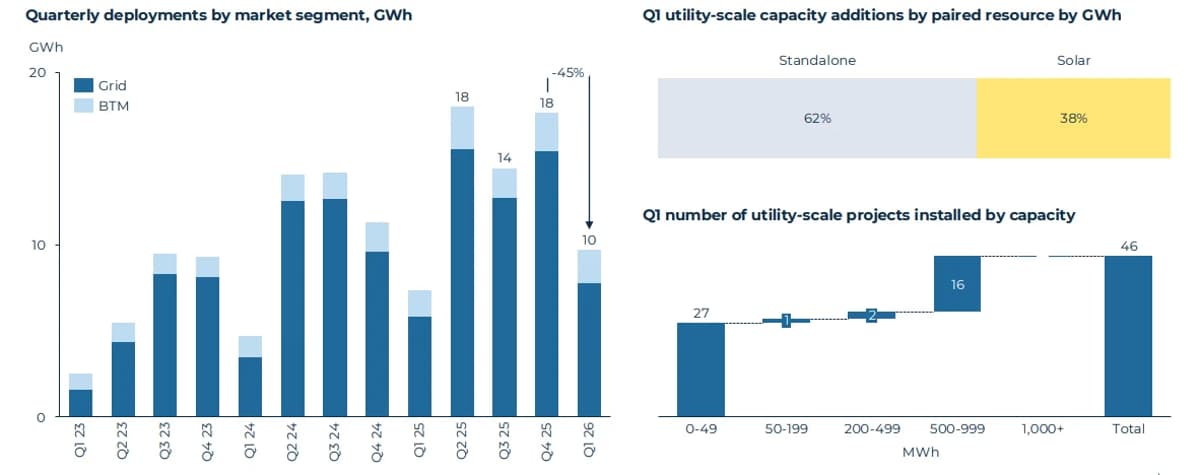
- •US installed 9.7 GWh BESS in Q1, up 32% YoY
- •Utility‑scale added 7.8 GWh, driven by Texas, Arizona, California
- •Residential storage fell 28% as 25D tax credit expired
- •Google and Meta pursue ultra‑long‑duration storage projects
- •SEIA forecasts >610 GWh storage by 2030 amid geopolitical risk
Pulse Analysis
The first quarter of 2026 marked a record‑setting period for U.S. battery energy storage, with 9.7 GWh coming online—an increase of roughly one‑third compared with the same period last year. Utility‑scale projects dominated the surge, delivering 7.8 GWh across key states such as Texas, Arizona and California, underscoring the continued appetite for large‑scale, grid‑supportive assets. This momentum reflects both the declining cost of lithium‑ion modules and the growing need for flexible resources to balance an expanding renewable portfolio.
Conversely, residential storage experienced a 28% contraction as the 25D tax credit lapsed, prompting developers to accelerate projects into the previous quarter to capture the incentive. The shift illustrates how policy incentives directly influence market pacing. At the same time, data‑center giants like Google and Meta are betting on ultra‑long‑duration storage technologies—iron‑air and solid‑oxide fuel cells—to secure reliable power for high‑density compute loads, signaling a diversification of storage applications beyond traditional peak‑shaving.
Looking ahead, SEIA’s revised outlook anticipates more than 610 GWh of cumulative storage capacity by 2030, a trajectory amplified by geopolitical tensions that have spiked fossil‑fuel prices and highlighted energy‑security concerns. However, the sector faces permitting bottlenecks, with 467 solar‑plus‑storage projects awaiting approval, potentially slowing deployment and raising electricity costs. Stakeholders will need to navigate regulatory risk while capitalizing on the clear economic case for storage as a hedge against volatile fuel markets and a catalyst for deeper renewable integration.
US installed 9.7GWh of new BESS in Q1 2026, SEIA reports
Comments
Want to join the conversation?
Loading comments...