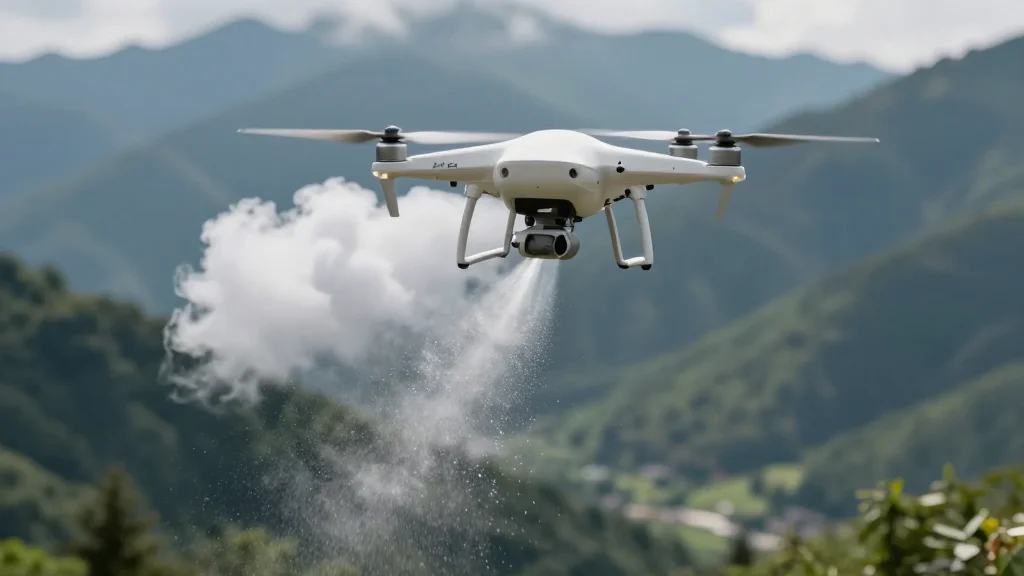
Using Drones for Cloud-Seeding Can Trigger Rain, Company Claims

Why It Matters
If the validation holds, drone‑enabled cloud seeding could become a cost‑effective tool for alleviating water scarcity in drought‑prone regions, reshaping water‑resource strategies for municipalities and agriculture.
Key Takeaways
- •Rainmaker used drones to disperse silver iodide, generating 143 M gallons water
- •Company claims 1,750 households’ annual water use matched by seeding
- •Unique flight patterns enable radar signatures linking drones to precipitation
- •GAO still labels cloud‑seeding benefits as unproven
- •Utah official says cost per water unit is extremely low
Pulse Analysis
Cloud‑seeding has long promised to augment natural precipitation, but its efficacy has been clouded by methodological hurdles. Traditional aircraft‑based dispersal faces logistical costs and limited precision, prompting innovators to explore unmanned platforms. Rainmaker’s 2023 launch leverages lightweight drones to release silver iodide—a proven ice‑nucleating agent—directly into targeted cloud cells. By programming unique flight grids, the firm creates traceable patterns that can be cross‑referenced with high‑resolution radar and satellite data, producing what it calls unambiguous seeding signatures.
The technical novelty lies in marrying autonomous flight with real‑time atmospheric sensing. Advanced doppler radar tracks micro‑scale changes in reflectivity, while satellite imagery captures transient cloud‑top depressions, or “holes,” that align with drone pathways. This dual‑sensor approach attempts to overcome the Government Accountability Office’s criticism that cloud‑seeding outcomes lack a control baseline. Although Rainmaker reports 82 distinct signatures and 143 million gallons of added water—equivalent to the annual consumption of roughly 1,750 households—skeptics caution that correlation does not equal causation, and broader peer‑reviewed studies remain pending.
Should Rainmaker’s methodology gain regulatory endorsement, the implications for water‑stress regions are significant. The Western United States faces chronic drought, and traditional water‑rights allocations struggle to keep pace with agricultural and urban demand. Low‑cost, drone‑driven precipitation could supplement reservoirs, support the Great Salt Lake’s declining levels, and reduce reliance on energy‑intensive desalination. However, scaling the technology will require coordinated policy frameworks, environmental impact assessments, and transparent data sharing to address concerns about aerosol fallout and ecosystem disruption. As climate variability intensifies, private‑sector cloud‑seeding may emerge as a strategic lever in the broader water‑security toolkit.
Using Drones for Cloud-Seeding Can Trigger Rain, Company Claims
Comments
Want to join the conversation?
Loading comments...