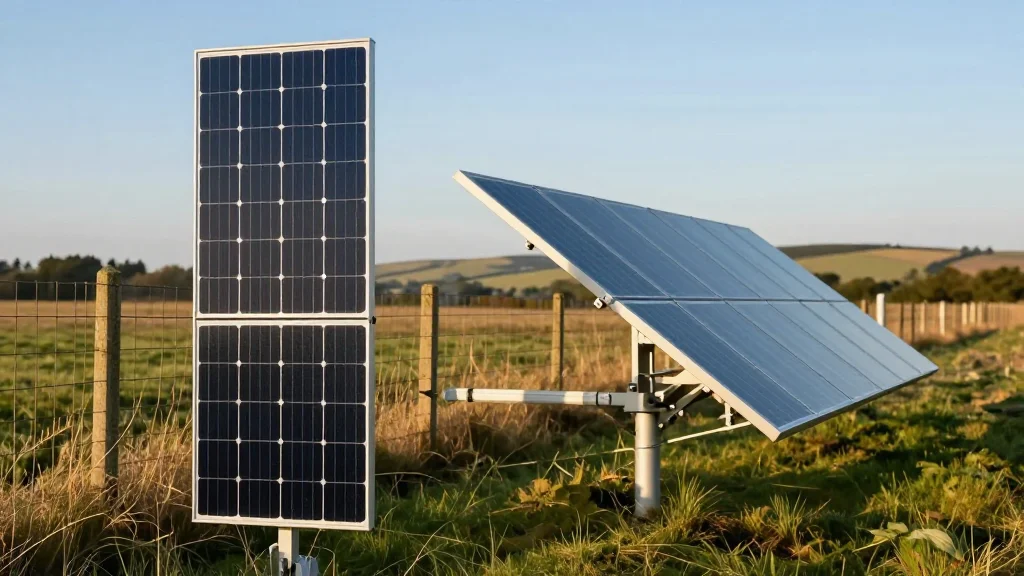
Vertical Bifacial PV Outperforms Tilted PV Systems in the UK
Why It Matters
The technology boosts renewable generation when electricity prices are highest, easing grid congestion and reducing the need for costly storage, while offering a stronger business case for rooftop solar investors.
Key Takeaways
- •Vertical bifacial PV yields up to 27% morning power vs tilted panels
- •Winter output gains reach 24.5%, surpassing all seasons
- •Bifacial design adds ~12% extra yield over vertical monofacial in winter
- •Higher generation aligns with peak residential demand, reducing storage needs
- •Cost $1,630/kW; extra yield shortens payback despite higher upfront
Pulse Analysis
The UK’s diffuse, low‑angle winter sun has long challenged conventional solar installations, which are optimized for direct, high‑sun trajectories. Vertical bifacial panels flip that paradigm by standing upright and exploiting reflected light from the ground or surrounding surfaces. By using heterojunction cells with 22.5% efficiency and a white‑gravel substrate, the system captures photons on both faces, turning otherwise wasted illumination into usable electricity. This geometry not only maximizes roof real estate but also blends with modern architecture, offering an aesthetic advantage alongside performance gains.
Performance data from the University of York’s 2023‑24 monitoring campaign reveal consistent superiority over tilted monofacial arrays. Morning output between 05:30 and 09:00 surged by 26.9%, while evening generation rose 22.8%, effectively creating a “double‑peak” profile that coincides with residential heating, cooking and electric‑vehicle charging spikes. Seasonal analysis shows gains of 14.8% in summer, 19.3% in spring, 20.3% in autumn and a striking 24.5% in winter, even outpacing a vertical monofacial reference by 12.5% during the coldest months. These higher yields translate into an estimated £1,221 (≈$1,650) extra annual savings per 1,500 kWh baseline, shortening the payback horizon despite a $1,630/kW capital cost versus $1,200/kW for standard panels.
The commercial implications are significant. Over Easy Solar is leveraging the study to accelerate entry into the UK and Irish markets, where high wind speeds and limited roof space demand robust, space‑efficient solutions. CFD simulations confirm negligible lift at wind speeds up to 98 km/h, reassuring developers about structural resilience. As electricity tariffs rise during winter and grid operators grapple with congestion, vertical bifacial PV offers a low‑cost, low‑storage alternative that can be retrofitted onto existing rooftops. With similar technology already proving its worth in snowy Norway and the emerging U.S. market, the UK case study could catalyze broader adoption across temperate regions seeking to extract maximum value from limited solar resources.
Vertical bifacial PV outperforms tilted PV systems in the UK
Comments
Want to join the conversation?
Loading comments...