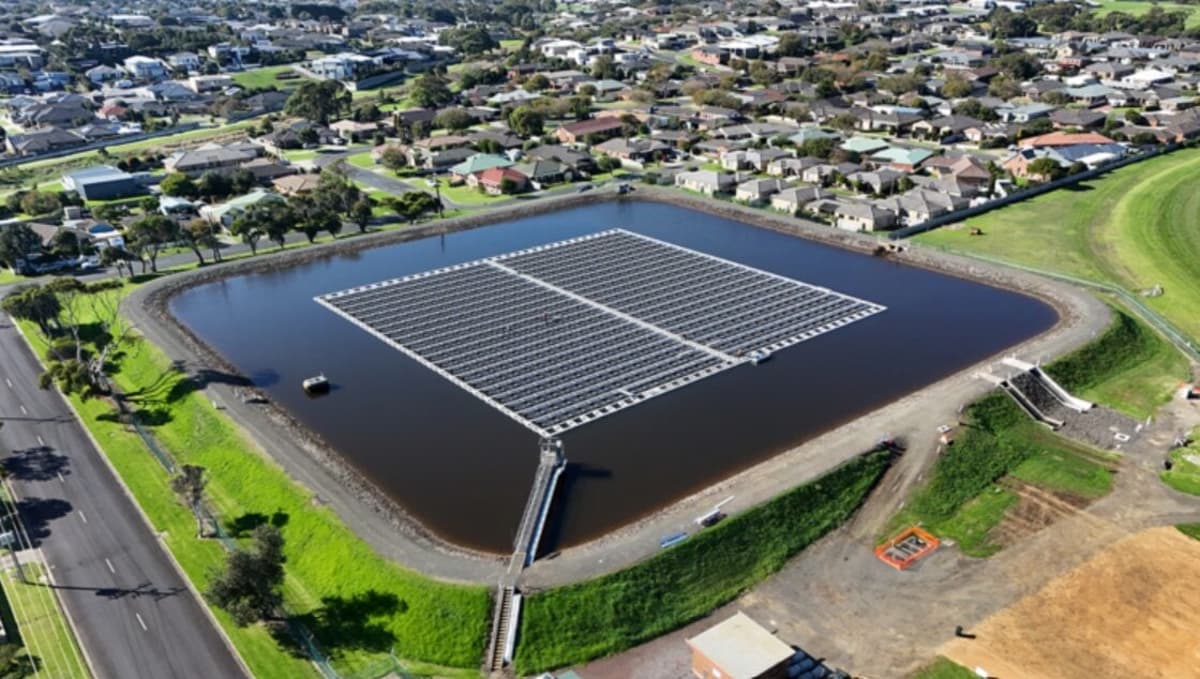
Wannon Water, Enervest Complete ‘One of Australia’s Largest Floating Solar Arrays’
Companies Mentioned
Why It Matters
The array reduces Wannon Water’s operating costs and carbon footprint, demonstrating how utilities can leverage floating solar to meet sustainability goals while addressing water‑energy nexus challenges.
Key Takeaways
- •500 kW floating solar array completed at Brierly Basin reservoir
- •Generates >600,000 kWh annually, cutting water‑pumping energy costs
- •Project cost AU$2 million (≈US$1.4 million) funded by Enervest
- •Supports Wannon Water’s net‑zero by 2030, avoiding 600 t CO₂
- •Highlights growing Australian floating‑solar market, backed by ARENA research
Pulse Analysis
The new 500 kW floating solar plant at Brierly Basin showcases how bifacial modules on high‑density polyethylene pontoons can boost efficiency by capturing reflected sunlight. Delivering more than 600 MWh annually, the system directly powers the pumps that move water uphill to Wannon Water’s treatment facility, shaving roughly AU$200,000 in electricity costs each year. By integrating generation at the water source, the utility sidesteps transmission losses and leverages otherwise idle reservoir space, delivering a cost‑effective renewable solution for a traditionally energy‑intensive operation.
Australia’s floating‑solar sector is gaining momentum, spurred by ARENA’s AU$13 million research programme and the NEESTI initiative targeting irrigators. These efforts aim to quantify technical performance, develop policy frameworks, and unlock water‑saving benefits—up to 296 GL annually if half of the nation’s 16.6 GW ground‑mounted solar were relocated to water bodies. Early adopters like Wannon Water, Hamilton, and Warrnambool utilities are proving the model’s viability, while international players such as Norway’s Ocean Sun bring advanced membrane‑based floaters that promise 10 % higher yields through superior heat dissipation.
For water utilities, floating solar offers a dual advantage: lower energy bills and a clear pathway to decarbonisation. The Brierly Basin project aligns with Wannon Water’s 2030 net‑zero pledge, cutting more than 600 tonnes of CO₂ annually. As capital costs fall and performance data accumulate, floating solar is poised to become a mainstream asset class, especially for regions with limited land but abundant water infrastructure. Investors and policymakers should watch this niche closely, as it could reshape renewable‑energy procurement strategies across the utility sector.
Wannon Water, Enervest complete ‘one of Australia’s largest floating solar arrays’
Comments
Want to join the conversation?
Loading comments...