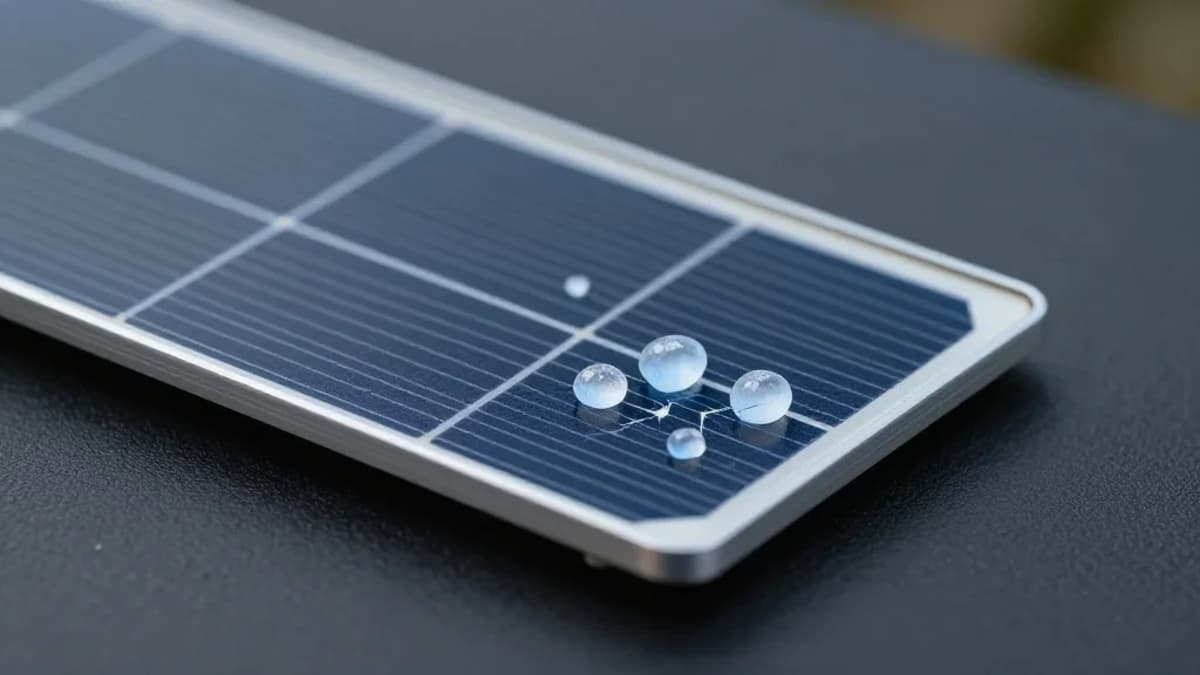
When Hail Hits PV: New Research Maps Damage, Testing, and Mitigation
•February 24, 2026
0
Why It Matters
Hail poses a growing reliability threat to rapidly expanding solar assets, and mitigating it protects billions of dollars of investment and grid stability. Understanding damage mechanisms and effective safeguards helps developers and manufacturers reduce downtime and insurance costs.
Key Takeaways
- •2023 saw 9,882 large hail events across Europe.
- •Texas utility PV plant lost 400k modules in 2019 storm.
- •Glass thickness and tilt angle reduce hail damage.
- •IEC TS 63397 offers stricter hail‑impact testing than IEC 61215.
- •Active mitigation includes trackers, protective netting, mobile systems.
Pulse Analysis
The accelerating deployment of solar farms worldwide has amplified exposure to extreme weather, and hail is emerging as a silent but costly adversary. Recent climate analyses show that large hailstorms are becoming more frequent in temperate zones, translating into billions of euros in property and crop losses each year. When a hailstone strikes a PV module, the kinetic energy can fracture the front glass, delaminate encapsulants, or crack cells, leading to immediate power loss and costly replacements. The review highlights that Europe alone recorded nearly ten thousand significant hail events in 2023, underscoring the urgency for the solar industry to address this risk.
Technical investigations detailed in the study reveal that module construction variables—glass thickness, encapsulant composition, and cell technology—directly influence hail resilience. Advanced testing methods such as digital image correlation and high‑speed imaging provide granular insight into impact dynamics, while simulation platforms model variables like ice‑sphere diameter, velocity, and turbulence. Notably, the IEC TS 63397 standard introduces more rigorous impact criteria than the traditional IEC 61215 certification, enabling manufacturers to certify modules against realistic hail scenarios and reduce field failures.
Mitigation strategies span passive design choices, such as increasing glass thickness and optimizing tilt angles, to active solutions like single‑axis trackers that adjust orientation during storms and deployable netting systems. The authors call for expanded research on impact angles, irregular hail shapes, and multi‑impact intervals, as well as refined predictive models that integrate local hail climatology with wind conditions. For investors and operators, adopting these insights can lower insurance premiums, extend asset lifespans, and safeguard the reliability of renewable energy portfolios in an increasingly volatile climate.
When hail hits PV: New research maps damage, testing, and mitigation
0
Comments
Want to join the conversation?
Loading comments...