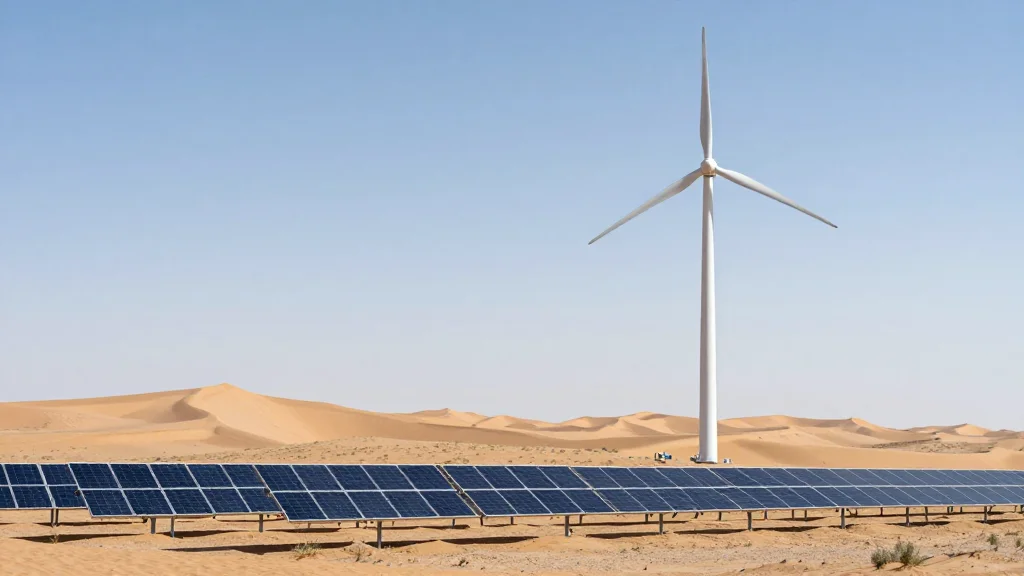
World’s Biggest Co-Located Wind and Solar Project Begins Operations in China
Companies Mentioned
Why It Matters
The plant adds a substantial, low‑carbon power source to China’s grid, helping meet the country’s aggressive renewable targets while demonstrating the efficiency gains of co‑locating wind and solar assets. Its success could accelerate similar hybrid projects worldwide, optimizing land use and grid stability.
Key Takeaways
- •Envision deployed 5.56 MW custom turbines for low-wind terrain.
- •Project combines wind and solar on 635,000 km² Loess Plateau.
- •Expected annual output exceeds 12 TWh, feeding eastern industrial coast.
- •Ultra‑high‑voltage lines will transmit power across thousands of kilometres.
- •Co‑location reduces land use and improves renewable capacity factor.
Pulse Analysis
China’s newest renewable landmark illustrates how hybrid wind‑and‑solar farms can thrive in rugged environments. The Loess Plateau, a 635,000 km² expanse traditionally viewed as resource‑constrained, now hosts Envision Energy’s custom 5.56 MW turbines and a sprawling solar array. By tailoring turbine design—large rotors and high capacity—to low‑wind, mountainous terrain, the project sidesteps the need for hundreds of smaller units, cutting construction complexity and visual impact.
The facility’s anticipated 12 TWh of annual generation will be channeled through ultra‑high‑voltage (UHV) lines to power‑hungry industrial zones along China’s eastern seaboard. This capacity not only bolsters the nation’s pledge to achieve carbon neutrality by 2060 but also improves grid reliability by smoothing intermittency; solar output peaks in daylight while wind contributes during breezier periods. Envision’s integrated approach reduces transmission losses and maximizes the capacity factor of both technologies, offering a template for other regions grappling with land scarcity and variable resources.
Globally, the project signals a shift toward co‑location as a pragmatic path to scale renewable energy without expanding land footprints. By demonstrating that sophisticated engineering can overcome topographical hurdles, Envision positions itself at the forefront of the next wave of clean‑energy infrastructure. Investors and policymakers will likely view this model as a cost‑effective strategy to accelerate decarbonization, especially in countries where terrain and land availability pose significant barriers.
World’s biggest co-located wind and solar project begins operations in China
Comments
Want to join the conversation?
Loading comments...