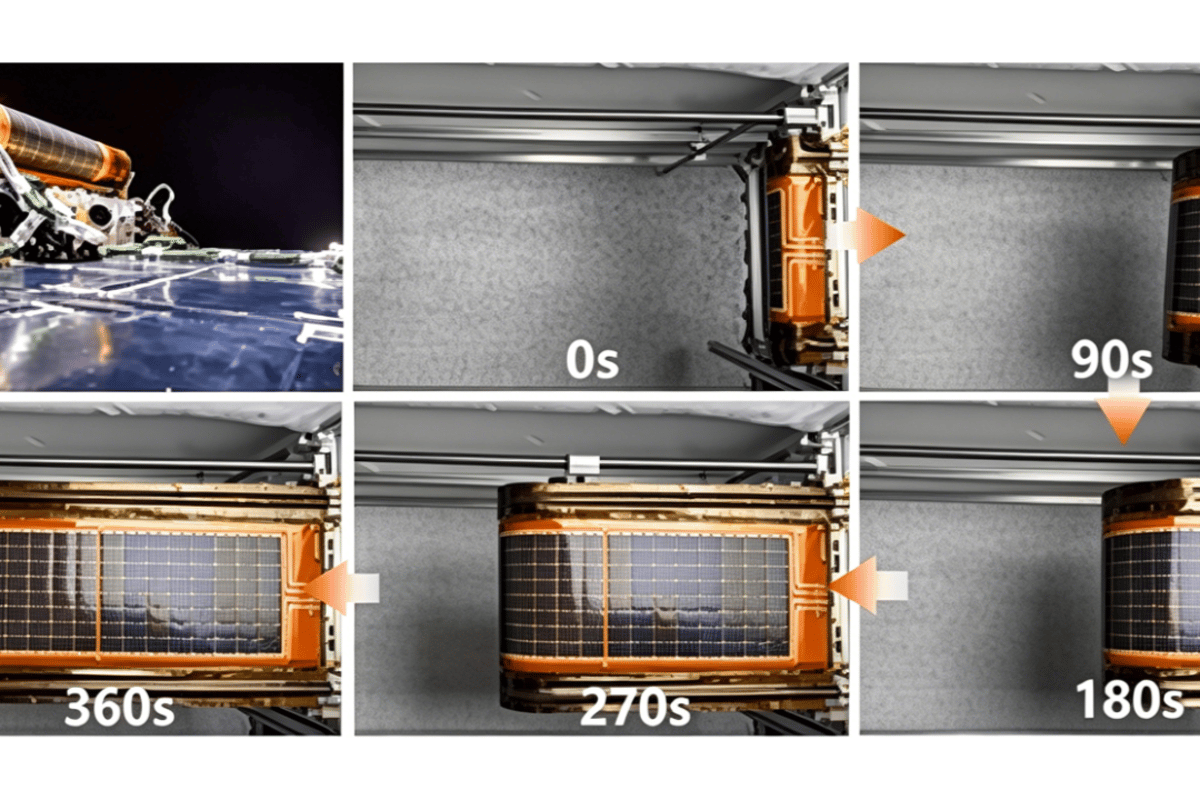
Zenix Announces Deployable On-Orbit Solar Array Using Smart Composite Materials
Why It Matters
The breakthrough reduces launch mass and volume while boosting power output, a critical advantage for small‑satellite constellations and cost‑sensitive commercial space operators.
Key Takeaways
- •Zenix's flexible array achieves up to 30% conversion efficiency in orbit.
- •Power‑to‑mass ratio is 2‑3× higher than rigid solar panels.
- •Self‑deploying, self‑locking composite booms reduce launch volume and complexity.
- •Production line at Suzhou Industrial Park enables mass‑production for constellations.
- •Technology also applied to optical light shields for deployable spacecraft subsystems.
Pulse Analysis
Satellite operators have long wrestled with the trade‑off between power generation and launch constraints. Traditional rigid solar panels offer reliable performance but add significant mass and require complex deployment mechanisms, limiting the number of satellites that can be launched per rocket. Zenix’s flexible solar array sidesteps these issues by integrating actuation and structural support into a single smart composite sheet, allowing the panel to roll up tightly for launch and unfurl autonomously once in orbit. This approach not only trims stowed volume but also simplifies the mechanical architecture, lowering both production and integration costs.
The core of Zenix’s innovation lies in its deformable composite material, which combines high‑efficiency photovoltaic cells with shape‑memory polymers that lock into a rigid configuration after deployment. In orbit, the array has demonstrated up to 30% conversion efficiency and a power‑to‑mass ratio two to three times that of conventional panels, translating into more watts per kilogram for small satellites. The system’s pod‑shaped and C‑shaped boom options provide designers with scalable configurations, while the winding‑and‑stretching mechanism ensures repeatable, low‑impact deployment—critical for constellations where thousands of units must operate reliably.
Commercially, Zenix’s transition to mass production at its Suzhou Industrial Park facility signals a shift from niche research to mainstream aerospace supply chains. By delivering a ready‑to‑integrate, high‑performance power solution, the company positions itself to capture a growing share of the satellite‑as‑a‑service market, where operators seek to maximize payload capacity and minimize launch expenses. Moreover, the underlying composite technology is being repurposed for optical light shields and other deployable subsystems, hinting at broader adoption across spacecraft design. As constellations expand, the demand for lightweight, autonomous, and efficient structures will only intensify, making Zenix’s smart composites a strategic asset for the next generation of space infrastructure.
Zenix announces deployable on-orbit solar array using smart composite materials
Comments
Want to join the conversation?
Loading comments...