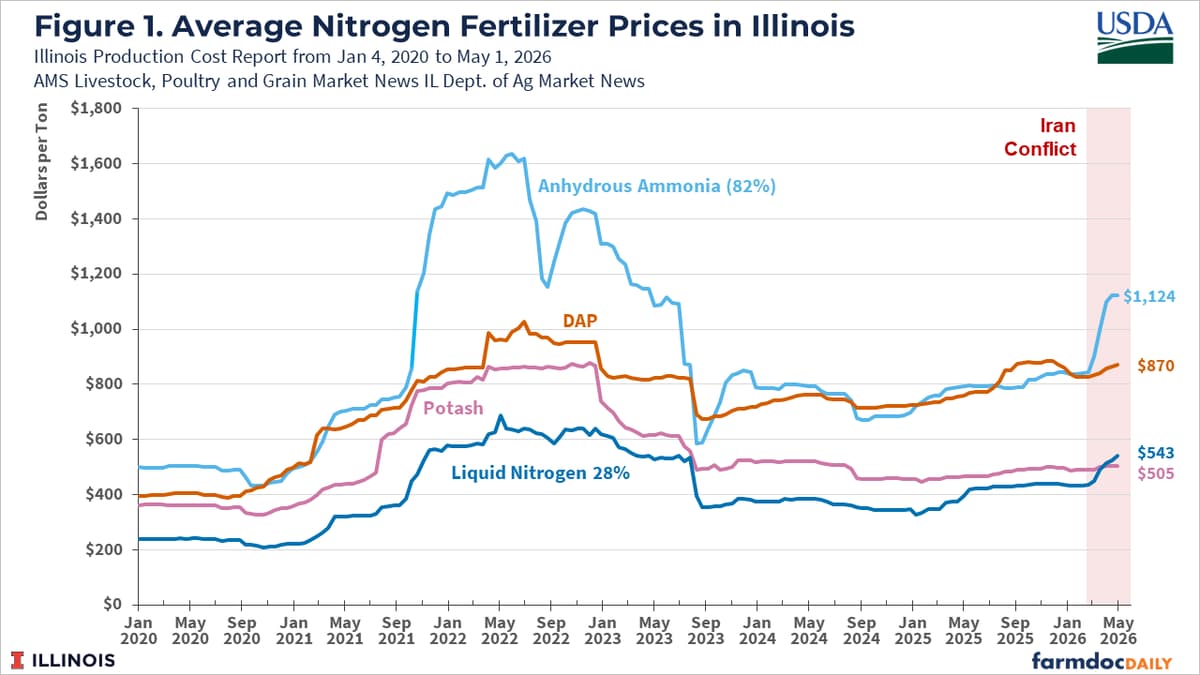
Fertilizer Cost Increases Resulting From the Iran Conflict
Key Takeaways
- •Anhydrous ammonia price jumped $295/ton, raising corn fertilizer cost $27/acre.
- •28% nitrogen solution rose 25%, adding $22/acre to corn costs.
- •Soybean fertilizer cost rose only $2/acre due to modest DAP/potash hikes.
- •Farms pre‑bought nitrogen avoid 2026 shock; 2027 impacts universal.
Pulse Analysis
The Iran conflict has exposed the fragility of global nitrogen supply chains, especially for the United States, which relies heavily on Middle‑East exports of anhydrous ammonia and urea. The closure of the Strait of Hormuz—a key maritime conduit for these commodities—triggered a rapid price escalation in early 2026. While the surge was most pronounced for nitrogen products, the ripple effect on phosphate and potash remained muted, reflecting their different sourcing patterns and lower immediate demand in the Midwest planting calendar.
For Illinois corn growers, the cost differential between ammonia and nitrogen solutions has become a decisive factor. Anhydrous ammonia, still the lowest‑cost nitrogen source, now adds roughly $27 per acre compared with pre‑conflict levels, whereas 28 % nitrogen solutions contribute an extra $22 per acre. Soybean producers feel a modest $2‑per‑acre increase because DAP and potash prices rose only marginally. Farmers who locked in fertilizer contracts before February are insulated for 2026, but those delaying purchases face a clear competitive disadvantage, prompting many to reconsider crop rotation choices and nitrogen management strategies.
Looking ahead to the 2027 season, the expectation is that nitrogen prices will settle above pre‑conflict baselines, while phosphate supplies could tighten if sulfuric‑acid disruptions persist, potentially pushing DAP toward $1,000 per ton. Producers are likely to adopt three tactical levers: lower nitrogen application rates to MRTN recommendations, increase reliance on anhydrous ammonia, and shift ammonia applications to post‑plant windows to avoid inhibitor costs. These adjustments, combined with the broader inflationary pressure from higher energy prices, could influence U.S. grain export competitiveness and feed into Federal Reserve policy deliberations on interest rates.
Fertilizer Cost Increases Resulting from the Iran Conflict
Comments
Want to join the conversation?